
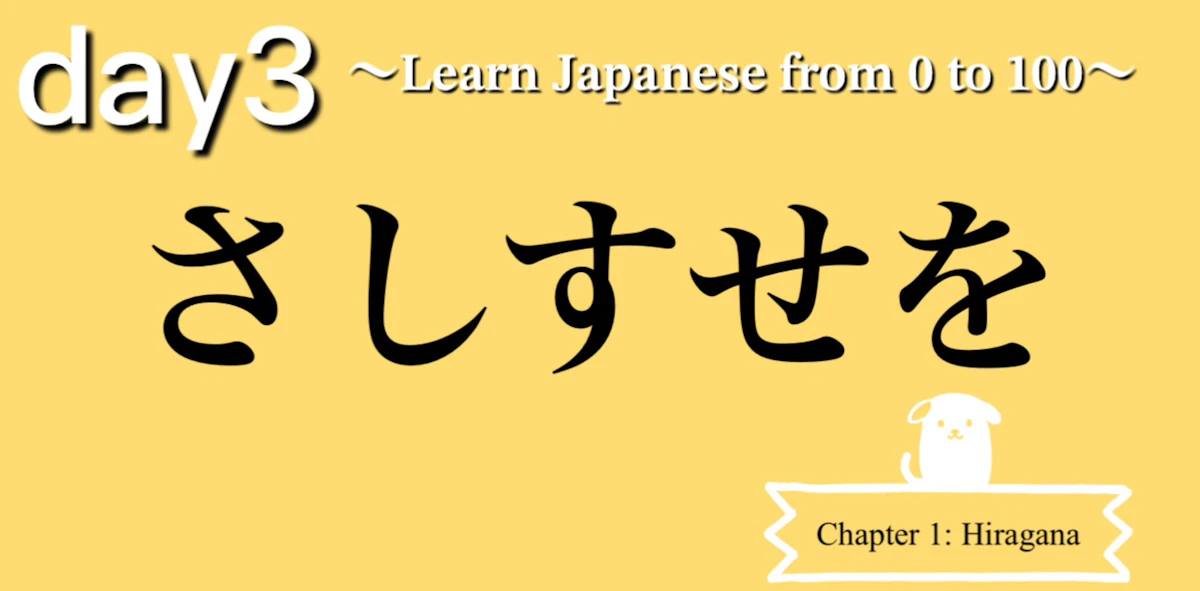
The S-row — さしすせそ — is your third set of hiragana characters, and it contains one of the most important pronunciation rules in the entire Japanese writing system: し is shi, not si. That single detail trips up beginners every day, and it's a perfect reason to give this row a little extra attention before moving forward.
By the end of this page you will be able to read and write all five characters, understand why they sound the way they do, recognize them in real vocabulary, and handle their voiced counterparts ざじずぜぞ. If you're just starting your hiragana journey, the A-row hiragana guide covering あいうえお explains how the hiragana grid is organized — a good foundation before tackling this row.
The SA Row in Hiragana: さしすせそ at a Glance
Here are all five S-row characters with their standard Hepburn romaji, a sound guide, and an example word to anchor each character in memory.
Hiragana | Romaji | Pronunciation guide | Example word |
|---|---|---|---|
さ | sa | "sah" as in "saga" | さかな (sakana) — fish |
し | shi | "she" as in "sheep" — NOT "si" | しお (shio) — salt |
す | su | "soo" with a very light u | すし (sushi) — sushi |
せ | se | "seh" as in "set" | せかい (sekai) — world |
そ | so | "so" as in "song" | そら (sora) — sky |
Each character represents one syllable. The consonant is always s, and the vowel (a / i / u / e / o) follows in the standard order — except that the i column uses shi rather than si. This is not a quirk of the writing system; it reflects the genuine phonetics of that sound in Japanese.
Pronunciation: How Each Character Really Sounds
さ (sa) — A clean, open ah vowel following a light s. Relax your tongue and jaw; there is no tension in this sound.
し (shi) — The most discussed character in this row. English speakers instinctively want to say si (as in "sit"), but the Japanese sound is shi — the tongue moves slightly further back, producing a sh quality before the ee vowel. Think of the English word "she" and you are very close.
す (su) — One of Japanese's subtler sounds. The u vowel is significantly compressed and often devoiced, especially in casual or fast speech. Aim for a very light soo rather than a full English "sue."
せ (se) — A crisp, short seh. Do not let it drift toward the English word "say" — the vowel is brief and the mouth stays relatively open.
そ (so) — A round, clear so. Think of the musical syllable "sol" without the final l.
Cultural note: The word すし (sushi) is a ready-made pronunciation demo for this entire row. The す (su) shows the compressed vowel in action, and し (shi) is exactly the sound that confuses beginners on paper. Most English speakers have been pronouncing both of these sounds correctly for years through the word "sushi" — they just never knew the hiragana behind them.
Stroke Order: How to Write さしすせそ
Correct stroke order builds muscle memory that makes your writing faster and more legible. Follow the sequence below carefully; speed comes naturally with repetition.
さ (sa) — 3 strokes 1. Short horizontal stroke at the top, left to right 2. Longer horizontal stroke below the first, left to right 3. A diagonal stroke beginning at the midpoint of stroke 2, curving down and to the right, then looping back to the left
し (shi) — 1 stroke 1. Begin slightly above the midline, stroke straight downward, then curve gently to the right — like a relaxed hook or an elongated comma
す (su) — 2 strokes 1. A short horizontal stroke at the top 2. A longer vertical stroke crossing the horizontal line, then curving into a small loop on the right side
せ (se) — 3 strokes 1. A short horizontal stroke at the upper left 2. A longer horizontal stroke below it, with a short perpendicular drop from its right end 3. A vertical stroke running down the left side of the character, curving gently to the right at the bottom
そ (so) — 1 stroke (2 strokes in some handwritten styles) 1. A curve that loops once near the top, then sweeps diagonally down to the right — imagine a loose, open "z" shape that curves instead of angles
Write each character ten times in stroke order before moving to the next. The act of writing, even slowly, builds recognition far faster than passive reading alone.
Vocabulary and Example Sentences
Learning characters inside real words is far more effective than drilling them in isolation. Here are common vocabulary items for each S-row sound, followed by five full sentences to practise reading in context.
Words by character: - さ: さかな (sakana) — fish; さむい (samui) — cold - し: しお (shio) — salt; しごと (shigoto) — work; しんぶん (shinbun) — newspaper - す: すし (sushi) — sushi; すき (suki) — like / love; すこし (sukoshi) — a little - せ: せかい (sekai) — world; せんせい (sensei) — teacher - そ: そら (sora) — sky; そこ (soko) — there / that place
Example sentences:
- すしがすきです。 Sushi ga suki desu. I like sushi.
- しおはどこですか? Shio wa doko desu ka? Where is the salt?
- そらはあおいです。 Sora wa aoi desu. The sky is blue.
- せんせいはやさしいです。 Sensei wa yasashii desu. The teacher is kind.
- さかなをたべます。 Sakana wo tabemasu. I will eat fish.
Try reading each sentence aloud before checking the romaji. Even when you are unsure, attempting to decode the hiragana builds the skill faster than reading the romanization first.
Voiced Variants: ざじずぜぞ (ZA JI ZU ZE ZO)
Once you know さしすせそ, you get five more characters almost for free. Add a small diacritic mark called dakuten (゛) — two short diagonal strokes — to the top right corner of any S-row character, and you produce its voiced equivalent in the Z-row.
Hiragana | Romaji | Pronunciation guide | Example word |
|---|---|---|---|
ざ | za | "za" as in "pizza" | ざっし (zasshi) — magazine |
じ | ji | "jee" as in "jeep" | じかん (jikan) — time |
ず | zu | "zoo" | みず (mizu) — water |
ぜ | ze | "zeh" | かぜ (kaze) — wind; cold |
ぞ | zo | "zo" as in "zodiac" | ぞう (zō) — elephant |
A note on じ and ず: Two other characters — ぢ and づ — can also be romanized ji and zu respectively. In modern Japanese, じ and ず are used in the vast majority of words; ぢ and づ appear in only a handful of specific cases. As a beginner, default to じ for ji and ず for zu and you will be correct almost every time.
Common Mistakes Japanese Learners Make
Saying "si" instead of "shi" Some older romanization systems list し as si. While technically valid in one system (Nihon-shiki), this does not represent how the sound is actually produced. Use shi — it is what modern textbooks, keyboard IMEs, and Japanese teachers universally use. If the habit of typing "si" is already ingrained, practise associating し with the English word "she" until the correct sound comes automatically.
Overemphasizing the "u" in す Learners from European-language backgrounds tend to give the u vowel a full, round sound. Japanese す is much lighter. Listen carefully to desu (です) spoken by a native speaker — the final su is often barely audible. The same compression applies wherever す appears. You do not need to silence it entirely, but keep it brief and light.
Confusing ず (zu) and す (su) when typing す = su, ず = zu. When using a Japanese IME, typing "zu" produces ず, not す. Beginners sometimes swap these romanizations because the characters look visually distinct yet the romanized forms are easy to mix up when tired or moving quickly. If an unexpected character appears on screen, check the romanization first.
Mixing up さ and き visually さ and き (from the K-row) can look deceptively similar at first glance. The distinguishing feature: き has an extra horizontal stroke at the top, and its main vertical stroke does not form a loop. Compare them side by side until the difference becomes automatic.
Skipping stroke order because digital tools do not require it Flashcard apps and IMEs never ask you to draw characters correctly, so many learners skip stroke order entirely. When you eventually write by hand — in a notebook, in a tutoring session, or on a test — incorrect stroke order produces characters that look unsteady or ambiguous. Build the correct habit from the start; it costs little time now and saves considerable frustration later.
Practice Quiz
Cover the romaji column or answers below and test yourself. Scroll down only after you have made a genuine attempt.
Round 1 — Read the character
Hiragana | Your reading |
|---|---|
し | ? |
そ | ? |
ざ | ? |
せ | ? |
ず | ? |
Answers: shi / so / za / se / zu
Round 2 — Read the word
Word | Reading | Meaning |
|---|---|---|
すし | ? | ? |
そら | ? | ? |
しお | ? | ? |
せかい | ? | ? |
みず | ? | ? |
Answers: sushi (sushi) / sora (sky) / shio (salt) / sekai (world) / mizu (water)
Round 3 — Voiced or unvoiced?
Which of the characters below is the voiced version of す?
さ ず す せ
Answer: ず — it is す with a dakuten (゛) added to the top right corner, changing su to zu.
Want to put these characters to work in a real conversation right now? Start your Free Trial with Kind Japanese and practise reading さしすせそ aloud with a native Japanese teacher over LINE — you will receive real-time pronunciation feedback from your very first session.
FAQ
Why is し romanized as "shi" and not "si"?
Japanese し is produced with the tongue positioned slightly further back than for a plain s, creating a sh sound before the i vowel. Hepburn romanization — the most widely used system — captures this as shi to reflect how the sound is actually spoken. Older systems that write si exist but do not accurately represent the phonetics of this character.
How do I type さしすせそ on a keyboard or phone?
On a Japanese IME (Windows, Mac, iOS, or Android), switch to romaji input mode and type sa, shi (or si — most IMEs accept both), su, se, so. The IME converts these automatically to hiragana. For the voiced Z-row, type za, ji (or zi), zu, ze, zo.
Is the "u" in す really silent?
Not completely silent, but it is frequently devoiced — reduced to nearly nothing — in natural speech, especially when す appears between or after voiceless consonants. The clearest example is desu (です): native speakers often pronounce it closer to des than deh-soo. You do not need to force this devoicing as a beginner, but recognizing it will help you understand real spoken Japanese more quickly.
What is the difference between さ and ざ?
They share the same base shape. ざ has a dakuten (゛) — two small diagonal strokes — added to the top right corner, which voices the consonant and changes sa to za. The same pattern applies to all five S-row characters: さ→ざ, し→じ, す→ず, せ→ぜ, そ→ぞ.
Continue learning
Previous lesson: K-row hiragana (かきくけこ) — how to read, write, and pronounce KA KI KU KE KO
Next lesson: N-row hiragana (なにぬねの) — how to read, write, and pronounce NA NI NU NE NO
Once you are confident with the S-row sounds in hiragana, you may also want to compare them with the katakana SA SHI SU SE SO guide (サシスセソ), which covers the exact same pronunciation in the script used for loanwords and foreign names.
This article is Lesson 3 of the Kind Japanese 100-day beginner curriculum.

