
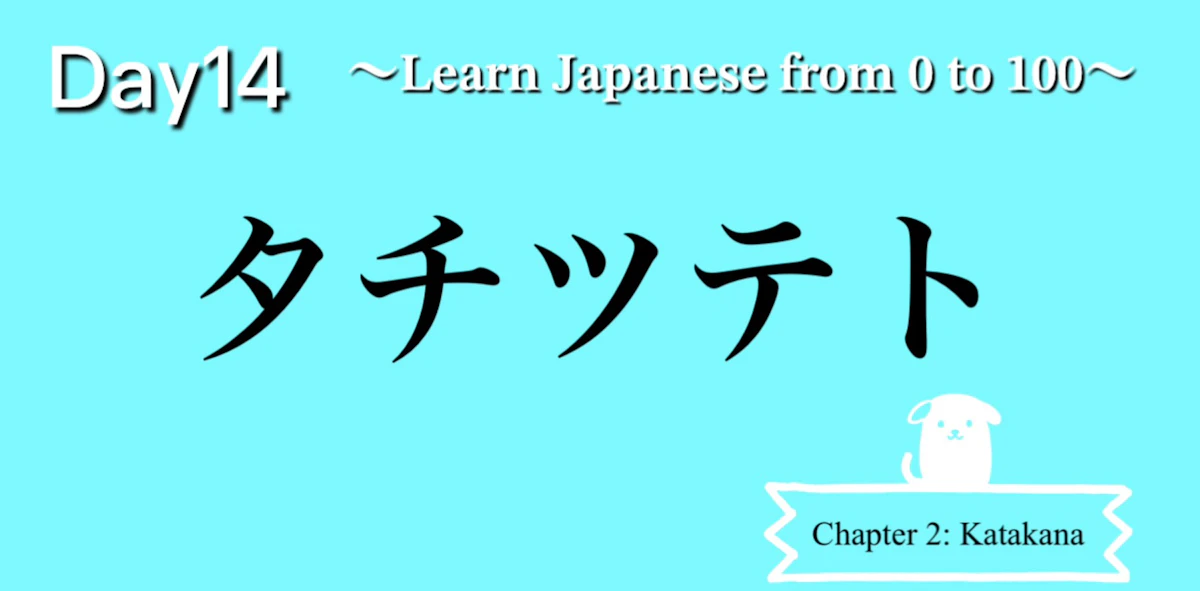
The T-row — タ チ ツ テ ト — punches well above its weight. Five characters unlock a whole shelf of everyday loanwords: taxis, cheese, tuna, tests, tomatoes. This guide gives you a clean reference table, a visual memory hook for every shape, honest pronunciation coaching for the genuinely tricky sounds, and a three-part quiz to prove you've locked them in.
The Five T-Row Characters at a Glance
Study each row in the table before reading on — character, sound, and a real loanword to anchor the shape in context.
Katakana | Romaji | Pronunciation note | Example loanword | English |
|---|---|---|---|---|
タ | ta | "tah" — short, open vowel | タクシー (takushī) | taxi |
チ | chi | "chee" — soft ch, never "ti" | チーズ (chīzu) | cheese |
ツ | tsu | "tsoo" — ts consonant cluster + u | ツナ (tsuna) | tuna |
テ | te | "teh" — crisp, short e | テスト (tesuto) | test |
ト | to | "toh" — short o | トマト (tomato) | tomato |
Romanization note: Hepburn romanization writes this row as ta, chi, tsu, te, to — not ta, ti, tu, te, to. You may find the second version in older textbooks or some input methods, but Hepburn better matches actual pronunciation and is the standard you'll encounter most often.
If you've just worked through the S-row katakana guide (サシスセソ), you'll notice that the T-row sounds are identical to hiragana た ち つ て と — these characters are a new shape for sounds you already know.
Memory Tricks: A Visual Hook for Every Shape
The single biggest upgrade you can make over raw repetition is a mnemonic — a mental image that ties shape to sound. Here is one for each character; adapt them to whatever clicks for you.
タ (ta) — The character has a short horizontal bar, a longer diagonal slash crossing through it, and a small tail dropping to the lower right. It looks like a flag on a pole, a tag flapping in the breeze. Tag → ta.
チ (chi) — Two horizontal bars stacked above a curved stroke that descends and hooks to the left, like a gymnast hanging from a bar and pulling up. Chin-up bar → chi.
ツ (tsu) — Two short inward-slanting dashes sitting above a long sweeping curve — like a cartoon face with two eyes and a wide grin. Picture a Tsunami wave cresting with a huge smile. Tsunami grin → tsu.
テ (te) — Two horizontal bars pierced by a vertical stroke that curves outward at the foot. It resembles a telephone pole with wires strung between the crossbars. Telephone pole → te.
ト (to) — A single vertical line with one short horizontal bar jutting to the right, about a third of the way down — a minimalist stake driven into the ground. Think of a totem pole post. Totem pole → to.
Katakana's sharp, angular shapes are deliberately different from the flowing curves of hiragana. That contrast is functional: when a native reader sees テレビ (terebi, TV) or コーヒー (kōhī, coffee) in a Japanese text, the boxy katakana letters immediately signal "foreign loanword" — no dictionary needed.
How to Write タチツテト
Correct stroke order builds reliable muscle memory and keeps characters legible. The guiding principle for this entire row: straight lines, sharp angles, no rounding.
- タ (3 strokes): Short horizontal bar → longer diagonal stroke crossing through it from upper center, sweeping to the lower right → small tail at the lower right.
- チ (3 strokes): First short horizontal stroke → second horizontal stroke below it → vertical stroke descending through the lower bar, hooking left at the bottom.
- ツ (3 strokes): First short diagonal slash (upper area) → second short diagonal slash just beside and below the first → long sweeping curved stroke from upper center, arcing down and to the right.
- テ (3 strokes): Top horizontal bar → second, longer horizontal bar below → vertical stroke through both bars, curving slightly outward at the foot.
- ト (2 strokes): Vertical stroke top to bottom → short horizontal bar jutting right, positioned about one-third down the vertical.
After writing each character five times in isolation, practice the full row — タ チ ツ テ ト — as a continuous sequence without pausing. Uninterrupted repetition builds the row as a unit, which is how you'll encounter it in the wild.
Pronunciation: Getting the Tricky Sounds Right
ツ (tsu) trips up almost every English-speaking learner. English has no ts cluster at the start of a word, so instinct pushes toward "too." The fix: take the ts sound from the English word "its" and attach a short u immediately after — tsu. Keep the t firm and distinct; do not swallow it into a soft "choo."
チ (chi) is simpler but still catches learners who see the alternative romanization "ti" and pronounce it "tee." It is always "chee," identical to the start of the English word "cheese" — which makes the example word チーズ (chīzu) a built-in self-test.
タ, テ, ト are straightforward. Their vowel sounds are close to the vowels in "taco," "bed," and "toll." Keep all five sounds in this row short and clipped — Japanese vowels are not drawn out the way English vowels often are.
T-Row Katakana in Real Sentences
Five natural sentences show you how T-row katakana appears in everyday Japanese, blending with hiragana and kanji exactly as it does on signs, menus, and messages. Read each one aloud.
- タクシーを呼んでください。 Takushī o yonde kudasai. Please call a taxi.
- このチーズはとてもおいしいです。 Kono chīzu wa totemo oishii desu. This cheese is really delicious.
- テストは明日です。 Tesuto wa ashita desu. The test is tomorrow.
- トマトが好きですか? Tomato ga suki desu ka? Do you like tomatoes?
- ツナサンドをください。 Tsuna sando o kudasai. I'll have a tuna sandwich, please.
Reading these sentences aloud is far more effective than silent study. Your ears begin to pattern-match the sounds even as your eyes are still learning the shapes.
Common Mistakes with the T-Row
Confusing ツ (tsu) and シ (shi) is the most common error in this section of the katakana table, and it is completely understandable — both characters use three strokes and similar proportions. The distinction is orientation.
In ツ, the two short strokes sit near the top of the character and lean inward, like two eyes looking at each other. The long stroke sweeps downward and to the right. The whole character reads horizontally — imagine a smiling face lying on its back.
In シ, the two short strokes sit on the left side of the character and lean outward, like two commas pointing right. The long stroke sweeps upward and to the right. The whole character reads vertically — imagine a face standing upright.
Quick check: if the short strokes feel stacked on top of one another, you are looking at ツ. If they feel side by side, it is シ.
A closely related confusion pair, ソ (so) and ン (n), follows the exact same horizontal-vs-vertical logic and appears further in the katakana table. Getting these pairs wrong changes words entirely — a native reader who sees ツナ (tsuna, tuna) misread as シナ (shina, an archaic geographic term) will do a genuine double-take.
Learners also frequently allow ツ to drift into a soft "choo." The t must be crisp and present before the s. Exaggerate it in early practice — t — ts — tsu — then smooth the transitions once the muscle memory is there.
Watch the tail on チ: the hook at the bottom must curve to the left. A straight downward stroke turns it into something that resembles ニ (ni), which belongs to an entirely different row.
Ready to have these mistakes caught in real time? Book a Free Trial lesson over LINE and practice タチツテト with instant pronunciation feedback from a live tutor — no amount of solo drilling replicates what a real teacher's ear can do.
Practice Quiz
Test yourself on all five characters. Cover the answer column, write your answers on paper, then check the key.
Part 1 — Read the Katakana
No. | Katakana | Your Answer |
|---|---|---|
1 | タ | ? |
2 | チ | ? |
3 | ツ | ? |
4 | テ | ? |
5 | ト | ? |
Part 2 — Write the Katakana
No. | Romaji | Your Answer |
|---|---|---|
6 | ta | ? |
7 | chi | ? |
8 | tsu | ? |
9 | te | ? |
10 | to | ? |
Part 3 — Read the Words
No. | Word | Your Answer |
|---|---|---|
11 | タクシー | ? |
12 | チーズ | ? |
13 | ツナ | ? |
14 | テスト | ? |
15 | トマト | ? |
Answer Key
No. | Answer |
|---|---|
1 | ta |
2 | chi |
3 | tsu |
4 | te |
5 | to |
6 | タ |
7 | チ |
8 | ツ |
9 | テ |
10 | ト |
11 | takushī — taxi |
12 | chīzu — cheese |
13 | tsuna — tuna |
14 | tesuto — test |
15 | tomato — tomato |
FAQ
Is ツ really pronounced "tsu" and not "tu"?
Yes — always tsu. The ts cluster is a genuine Japanese consonant; softening it to "tu" changes the sound and will confuse native speakers. Practice by isolating the ts from the English word "its," then attaching a short u immediately after: tsu. It becomes automatic within a few deliberate practice sessions.
What is the fastest way to tell ツ and シ apart?
Check orientation: ツ reads horizontally — the two short strokes sit on top like a pair of eyes. シ reads vertically — the two short strokes sit to the left like a pair of commas. If the character looks like a smiling face lying down, it is ツ. If it looks like a face standing upright, it is シ. Writing both side by side ten times locks the difference in.
Do I need all 46 katakana characters before I can read Japanese?
No — each row you finish immediately expands what you can read. The T-row alone lets you decode dozens of menus and signs right now. If you have not yet covered the vowels, the A-row katakana guide (アイウエオ) is the right starting point before working through this row.
How long does it take to memorize these five characters?
Most learners recognise all five T-row characters reliably after one focused 20-minute session, with a short review the following morning. Writing from memory usually needs one more session. Meeting the characters in real words — タクシー, テスト, トマト — rather than drilling them in isolation is consistently the fastest route to retention.
Continue Learning
- ← Previous: The S-row katakana guide (サシスセソ) — revisit this if the ツ / シ pair is still giving you trouble after this lesson.
- → Next: The H-row katakana guide (ハヒフヘホ) — five new characters, including one pronunciation challenge that surprises almost every learner.
When you reach the end of the main katakana table, the Wa-Wo-N katakana guide (ワヲン) covers the final row of the standard character set.
This article is Lesson 14 of the Kind Japanese 100-day beginner curriculum.

