
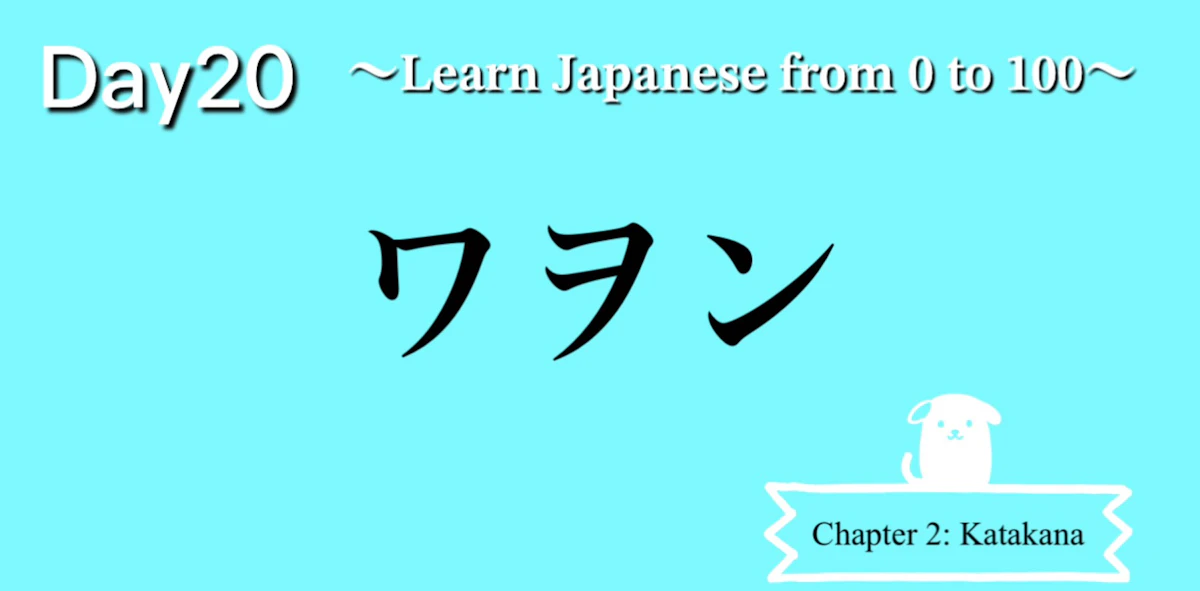
Meet ワ, ヲ, and ン: The Final Three Katakana
Reaching ワ, ヲ, and ン means you are one step away from reading the complete katakana syllabary. These three characters appear less often than many you have already learned — but ン is an exception. It is one of the highest-frequency characters in all katakana text, appearing at the end of hundreds of everyday loanwords. Master these three and no katakana word can stop you.
Character Reference: Shape, Reading, and Stroke Order
The table below is your quick cheat sheet for all three characters.
Katakana | Romaji | Sound in English | Key Notes |
|---|---|---|---|
ワ | wa | "wa" as in wand | Used in loanwords that start with the WA sound |
ヲ | wo | pronounced "o" | Almost exclusively the direct-object particle |
ン | n | nasal "n" | The only kana that stands alone as a consonant |
Stroke order at a glance
- ワ — 2 strokes. First, a horizontal line from left to right. Second, a short vertical stroke below the right end, angled slightly inward toward the center.
- ヲ — 3 strokes. First and second, two short horizontal lines at the top (the second slightly shorter). Third, a long sweeping curve from the upper-left down and across to the right.
- ン — 2 strokes. First, a short diagonal going up and to the right (↗). Second, a longer stroke that arcs briefly upward then hooks down and to the left.
Keep ワ angular when you write it. If the base rounds out, it starts to blur into ウ (u) — a common trap covered in the mistakes section below.
Visual Mnemonics to Make These Stick
A good mnemonic locks a shape into memory in seconds. Here are three that work:
ワ (wa) — Picture a walrus whose outline tapers at the top, matching ワ's narrow silhouette. The word walrus starts with W, and ワ represents the wa sound. Every time you see that tapering frame, think tusks.
ヲ (wo/o) — Think: Object. ヲ's entire job in modern Japanese is marking the grammatical object of a verb. The two horizontal bars at the top look like labels being placed on an item — flagging it as the object. And the sound? Simply "o".
ン (n) — Flip a capital N backwards and you get something strikingly close to ン. The shape is essentially a reversed N, and the sound is exactly "n". Once you see the reversed N, you cannot unsee it.
ワ, ヲ, ン in Real Katakana Words
ン dominates this list — that reflects how central it is in loanword vocabulary. ヲ does not typically appear in foreign words because its role is grammatical, not phonetic.
Katakana Word | Romaji | English Meaning |
|---|---|---|
ワイン | wain | wine |
ワンピース | wanpīsu | one-piece dress |
ワニ | wani | crocodile |
パン | pan | bread |
レモン | remon | lemon |
コンビニ | konbini | convenience store |
メロン | meron | melon |
バイオリン | baiorin | violin |
Cultural note: パン (bread) did not come from English — it entered Japanese from Portuguese pão, carried over by missionaries in the 16th century. It is one of the oldest surviving loanwords in modern Japanese and predates the flood of English-origin katakana vocabulary by roughly three hundred years. Most Japanese people have no idea it is Portuguese.
Example Sentences in Context
Read each sentence aloud to practise both pronunciation and reading simultaneously.
- ワインをのみます。 Wain o nomimasu. I drink wine.
- このパンはおいしいです。 Kono pan wa oishii desu. This bread is delicious.
- コンビニにいきます。 Konbini ni ikimasu. I'm going to the convenience store.
- レモンをかいました。 Remon o kaimashita. I bought a lemon.
- バイオリンをひきます。 Baiorin o hikimasu. I play the violin.
Notice the particle を appearing in sentences 1, 4, and 5 — written in hiragana here, it becomes ヲ in all-katakana contexts. You covered the hiragana form in the hiragana わをん guide, and the grammar is identical in katakana.
Common Mistakes — and How to Avoid Them
1. Confusing ン and ソ
This is the most common stumbling block for English-speaking learners of katakana.
Character | Romaji | Identifying Feature |
|---|---|---|
ン | n | First stroke angles up-right ↗; second stroke curves down to the left |
ソ | so | Both strokes angle down-right ↘; long stroke curves to the right |
The rule is simple: look at where the first short stroke points. Northeast (up-right) = ン. Southeast (down-right) = ソ. Practise ソ in context with the katakana サシスセソ guide until the distinction is automatic.
A closely related confusion appears with ツ (tsu) and シ (shi) — same family of "two short strokes plus one long stroke," same problem of stroke direction. The katakana タチツテト guide works through ツ in detail if that pair is tripping you up.
2. Pronouncing ヲ as "wo"
Modern standard Japanese pronounces ヲ as a plain "o" — identical to オ. The "wo" reading is archaic. When you see ヲ, say "o" and move on.
3. Assuming ン always sounds the same
ン is a nasal consonant that shifts slightly depending on what follows:
- Before m, b, p sounds → shifts toward an "m" (e.g., パン pan, サンポ sanpo)
- Before k, g sounds → shifts toward "ng" as in sing (e.g., アンコ anko)
- At the end of a word or before a vowel → a clear, resonant nasal "n"
You don't need to force these shifts — they happen naturally as your speaking fluency develops. Knowing they exist stops you from second-guessing yourself when a native speaker's ン sounds slightly different from word to word.
4. Making ワ too round
ワ should have clean, slightly angular lines. When learners round the base, it converges on ウ (u). Keep the lower portion pointed, not curved — think sharp and narrow, not soft and open.
Want real-time feedback on your katakana handwriting? Start a Free Trial lesson over LINE and a Kind Japanese tutor will correct your written characters live, one-on-one, exactly where you need it.
Practice Quiz: ワ, ヲ, and ン
This quiz focuses on the three new characters and their most commonly confused neighbours.
Part 1 — Read the katakana
# | Katakana | Your Answer |
|---|---|---|
1 | ワ | ? |
2 | ヲ | ? |
3 | ン | ? |
4 | ソ | ? |
5 | ウ | ? |
Part 2 — Write in katakana
# | Romaji | Your Answer |
|---|---|---|
6 | wa | ? |
7 | n | ? |
8 | so | ? |
9 | wo (particle) | ? |
10 | u | ? |
Part 3 — Decode these loanwords
# | Katakana | Romaji & Meaning |
|---|---|---|
11 | ワイン | ? |
12 | パン | ? |
13 | レモン | ? |
14 | コンビニ | ? |
15 | バイオリン | ? |
Answers
# | Answer |
|---|---|
1 | wa |
2 | wo — pronounced "o" |
3 | n |
4 | so |
5 | u |
6 | ワ |
7 | ン |
8 | ソ |
9 | ヲ |
10 | ウ |
11 | wain — wine |
12 | pan — bread |
13 | remon — lemon |
14 | konbini — convenience store |
15 | baiorin — violin |
FAQ
How do you pronounce ヲ in Japanese?
In modern standard Japanese, ヲ is pronounced exactly like オ — a plain "o" sound. The historical "wo" pronunciation is no longer used in everyday speech. ヲ appears almost exclusively as the direct-object particle; you will rarely if ever encounter it as part of a foreign loanword.
What is the difference between ン and ソ?
The clearest difference is the direction of the first short stroke: ン's first stroke angles upward to the right (↗), while ソ's strokes both angle downward to the right (↘). Check the top-left area of each character — a northeast stroke means ン; a southeast stroke means ソ.
Can ン appear at the start of a word?
No. ン never begins a Japanese word or syllable — it only follows another kana. In romanization, an apostrophe separates ン from a following vowel or y to prevent misreading: ジン'イ (jin'i), not jini. This makes ン unique across the entire kana system.
Is ワ common in everyday katakana text?
ワ is relatively uncommon — it mainly appears in loanwords with the "wa" sound, such as ワイン (wine) or ワニ (crocodile). ン, by contrast, is one of the most frequent characters in any katakana text, closing hundreds of everyday loanwords from パン to バイオリン.
Continue Learning
You have now completed the full katakana syllabary — a genuine milestone in your Japanese journey.
- ← The katakana ラリルレロ guide — review the R-row characters covered in the lesson immediately before this one
- → Japanese numbers 11 to 100 — your next step now that katakana is complete
This article is Lesson 20 of the Kind Japanese 100-day beginner curriculum.

