
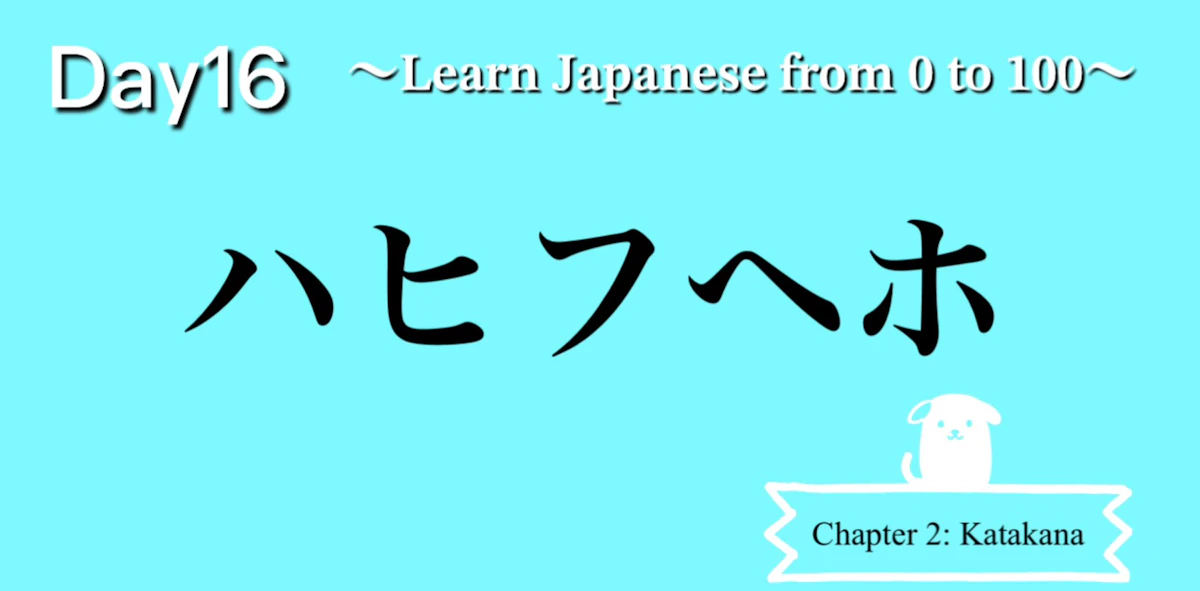
The Five Characters at a Glance
Building on the ta-row characters タチツテト you covered in the previous lesson, the H-row is one of the most rewarding groups to lock in. These five characters appear on hotel signs, restaurant menus, product labels, and packaging every single day across Japan.
Katakana | Romaji | Pronunciation guide |
|---|---|---|
ハ | ha | like "hah" — open and short |
ヒ | hi | like "hee" — close to English "he" |
フ | fu | soft bilabial breath — NOT a hard English "f" (see below) |
ヘ | he | like "heh" — not "hay" |
ホ | ho | like "hoh" — short and round |
Each of these characters shares its reading exactly with its hiragana counterpart (は・ひ・ふ・へ・ほ). If hiragana is already under your belt, the sounds here cost you nothing — the only new information is the shape.
Cultural note: Katakana is the script Japanese uses for loanwords from other languages. The H-row alone gives you words borrowed from English, French, and German: hoteru (hotel), hiiroo (hero), fooku (fork, from French fourchette). Recognising these five characters immediately unlocks dozens of everyday vocabulary items you already know the meaning of.
How to Pronounce ハヒフヘホ
Four of the five sounds are straightforward for English speakers:
- ハ (ha): A clean, open "ah" vowel with a light "h" in front — like the start of "harvest"
- ヒ (hi): The English word "he" — lips slightly spread
- ヘ (he): Like "heh" — the vowel is short and open, closer to the vowel in "bed" than the vowel in "say"
- ホ (ho): A short, round vowel — like a quick "hoe"
フ (fu): the sound that needs dedicated practice
フ trips up almost every English speaker. English "f" is a labiodental sound — your upper front teeth press against your lower lip. Japanese フ is entirely different: it is a bilabial fricative, formed with both lips. Bring both lips almost together as if you are about to blow out a candle, then let air pass through the narrow gap between them. No teeth are involved at all. The result sounds like a soft blend of "f" and "wh" — the opening of "who" with a touch of friction added. Practise フォーク (fooku, fork) and フルーツ (furuutsu, fruit) slowly in front of a mirror, checking that your upper teeth never make contact with your lower lip.
Stroke Order: How to Write ハヒフヘホ
Correct stroke order affects how naturally you write at speed and is required for handwriting recognition on Japanese smartphones. Practise on grid paper or in a kana workbook, and cross-reference with a stroke-order app such as Ringotan or KanjiStudy for animated sequences.
ハ (ha) — 2 strokes 1. A short diagonal stroke angling down to the lower-left. 2. A longer stroke starting from the upper area, curving slightly outward and sweeping down to the lower-right.
The two strokes lean away from each other like a pair of open parentheses.
ヒ (hi) — 2 strokes 1. A horizontal line across the top. 2. A vertical stroke starting below the left end of stroke 1, going straight down, then turning with a short rightward foot at the base.
フ (fu) — 1 stroke 1. Begin at the upper-left, sweep rightward across the top, then curve the line smoothly downward and inward, ending below the centre.
One continuous flowing arc — like the top of a fish hook.
ヘ (he) — 1 stroke 1. Start at the lower-left, rise to a central peak, then angle back down to the lower-right.
A simple rooftop shape. One of the easiest single strokes in all of katakana.
ホ (ho) — 4 strokes 1. A horizontal line across the middle. 2. A vertical line passing through the centre of stroke 1, written top to bottom. 3. A short diagonal stroke branching from the lower portion of stroke 2 to the lower-left. 4. A short diagonal stroke branching from the same point to the lower-right.
ホ has almost the same structure as the kanji 木 (ki, tree) — same stroke logic, nearly identical proportions.
Visual Mnemonics for ハヒフヘホ
A memory hook gives your brain a visual anchor for each shape. Use these in your first week of practice — once recognition becomes automatic, you will not need them anymore.
- ハ (ha): Two sumo wrestlers facing off, both leaning back before contact and shouting "HA!" Their bodies form the two diverging strokes.
- ヒ (hi): A chair seen from the side — a seat (the horizontal bar) and one leg (the vertical stroke). Sit in the chair and say "HEE!"
- フ (fu): A fish hook, curved and ready to cast. The breath to throw the line is a soft "FU."
- ヘ (he): A tent or rooftop shape — the simplest of the five. The house says "HE-llo" to anyone walking past.
- ホ (ho): A hot cross bun — the cross is right there in ホ. Ho ho ho.
Example Words and Sentences
The H-row is one of the most productive rows for loanwords. Every item below appears regularly in everyday Japanese, on menus, signage, and packaging:
Katakana | Romaji | English |
|---|---|---|
ハンバーガー | hanbaagaa | hamburger |
ハーフ | haafu | half; person of mixed heritage |
ヒーロー | hiiroo | hero |
ヒント | hinto | hint |
フォーク | fooku | fork |
フルーツ | furuutsu | fruit |
ヘルメット | herumetto | helmet |
ヘアサロン | hea saron | hair salon |
ホテル | hoteru | hotel |
ホームページ | hoomu peeji | website (lit. "home page") |
Example sentences — read each one aloud:
- ホテルはどこですか。
Hoteru wa doko desu ka.
Where is the hotel? - フォークをください。
Fooku o kudasai.
Please give me a fork. - ハンバーガーが食べたい。
Hanbaagaa ga tabetai.
I want to eat a hamburger. - このヘルメットは大きすぎます。
Kono herumetto wa ookisugimasu.
This helmet is too big. - 彼はヒーローです。
Kare wa hiiroo desu.
He is a hero.
Struggling to make these characters stick? Start your Free Trial lesson with a native teacher over LINE and practise ハヒフヘホ vocabulary in a real one-on-one conversation.
Common Mistakes with ハヒフヘホ
Using a hard English "f" for フ This is the single most frequent error. Learners whose first language includes a labiodental "f" — upper teeth meeting lower lip — default to that sound automatically. Japanese フ requires no teeth whatsoever. Practise in front of a mirror: if your upper teeth ever touch your lower lip, you are pronouncing it the English way. Adjust until the sound comes purely from your lips.
Confusing ヒ/ビ, ヘ/ベ, and ハ/バ Each of these pairs is the same base character with and without dakuten (゛), the two small marks that voice an unvoiced consonant. Learners often read ビ as hi or ヒ as bi when moving through text quickly. Build the habit of scanning for dakuten before reading any character. You will face the same challenge with the S-row characters サシスセソ, where サ/ザ, シ/ジ, and their pairs follow exactly the same voicing pattern — training the habit here pays dividends there.
Rounding the strokes of ハ ハ is built from clean, straight, angular strokes. Learners sometimes curve the right stroke until it resembles the hiragana は, blurring the distinct katakana shape. Keep every stroke crisp and straight.
Confusing ホ and ヌ Both ホ and ヌ have two diagonal strokes at the lower portion. The key difference: ホ has a clear horizontal line crossing its vertical stroke; ヌ does not. Write them side by side during practice to keep the distinction sharp.
Practice Quiz
Cover the right-hand columns and test yourself before moving on.
① Read — give the romaji reading for each character:
No. | Katakana | Reading |
|---|---|---|
1 | ハ | ? |
2 | ヒ | ? |
3 | フ | ? |
4 | ヘ | ? |
5 | ホ | ? |
② Write — write the katakana for each romaji:
No. | Romaji | Katakana |
|---|---|---|
6 | ha | ? |
7 | hi | ? |
8 | fu | ? |
9 | he | ? |
10 | ho | ? |
③ Words — translate these katakana words into English:
No. | Word | Meaning |
|---|---|---|
11 | ハンバーガー | ? |
12 | ヒーロー | ? |
13 | フォーク | ? |
14 | ヘルメット | ? |
15 | ホテル | ? |
Answers
No. | Answer |
|---|---|
1 | ha |
2 | hi |
3 | fu |
4 | he |
5 | ho |
6 | ハ |
7 | ヒ |
8 | フ |
9 | ヘ |
10 | ホ |
11 | hamburger |
12 | hero |
13 | fork |
14 | helmet |
15 | hotel |
FAQ
Is フ really pronounced differently from the English "f"?
Yes — noticeably so. English "f" is labiodental: upper teeth meet the lower lip. Japanese フ is bilabial: both lips nearly close, air flows through the gap, and no teeth are involved at all. Native speakers hear the difference immediately. A few focused minutes practising フォーク and フルーツ is enough to start building the correct muscle memory.
Do ハヒフヘホ sound exactly the same as はひふへほ in hiragana?
Yes, completely. Katakana and hiragana represent identical sounds — the scripts differ only in shape and usage context. Katakana marks loanwords, foreign names, and emphasis; hiragana handles native Japanese words and grammatical elements. The sounds themselves do not change between the two scripts.
What is the most effective way to memorise which shape is which?
Use the mnemonics above as a starting point, then reinforce recognition through whole words rather than isolated character drills. Reading ホテル, ヒント, and フォーク in full sentences activates memory of the shape in context. Short daily sessions of five to ten minutes consistently outperform occasional long study blocks.
What comes after ハヒフヘホ in the katakana chart?
The next row is the M-row: マミムメモ (ma, mi, mu, me, mo). The chart continues from there through several more rows until you reach the final katakana characters ワヲン, which completes the core katakana set.
Continue learning:
- ← The ta-row characters タチツテト (ta, chi, tsu, te, to) — the row covered just before this one
- → The ma-row characters マミムメモ (ma, mi, mu, me, mo) — the next step in your katakana journey
This article is Lesson 16 of the Kind Japanese 100-day beginner curriculum.

