
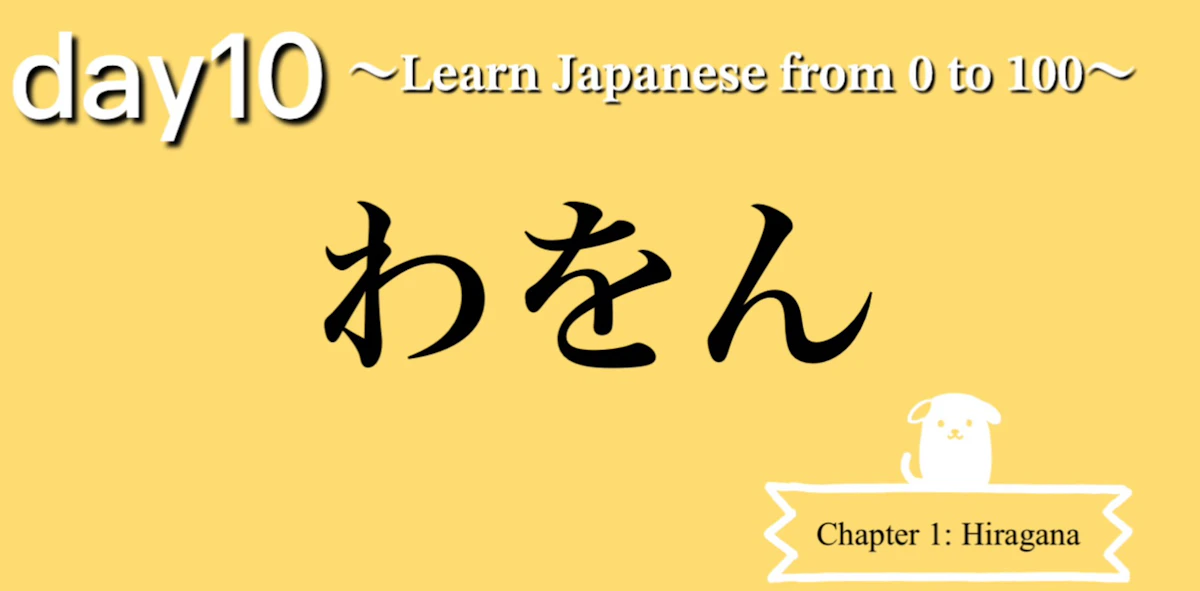
You have reached the end of the hiragana chart. Three characters stand between you and the ability to read every basic Japanese syllable: わ (wa), を (wo/o), and ん (n). This guide explains how to pronounce, write, and recognise each one — with a focused look at を, the particle that trips up almost every beginner, and a full 20-question hiragana review to confirm you have the whole chart locked in.
わ, を, and ん at a Glance
All three characters belong to the わ-row, which in modern Japanese contains just these three sounds. Here is your core reference:
Hiragana | Romaji | English / Notes |
|---|---|---|
わ | wa | "wah"; used in words and as the casual topic marker in informal writing |
を | wo | Pronounced "o" in modern Japanese; used exclusively as the direct-object particle |
ん | n | A standalone nasal consonant; the only hiragana without an attached vowel |
Chart romanization vs. spoken Japanese: を appears as "wo" in hiragana tables — including this one — because that is its historical name and the romanization used in dictionaries and kana charts. In actual spoken Japanese it is always pronounced "o." Drilling "wo" in isolation is fine; say "o" in every real sentence.
How to Pronounce わ, を, and ん
わ — wa Produce a clean "wah" sound, as in the English exclamation. Your mouth opens wide and the sound is short — one beat, no diphthong. わ never slides into "waa" or "way."
を — o In daily speech, を sounds exactly like お — the "o" in おはよう (ohayō, good morning). The romanization "wo" is a relic from classical pronunciation. Hear it in any modern Japanese sentence and you will instantly recognise it as a plain, short "o."
ん — n ん is unique: it is the only hiragana that represents a consonant with no attached vowel. Its exact sound shifts automatically depending on what follows it:
- Before b, p, or m — sounds like "m" (e.g., さんぽ, sanpo, "stroll," is pronounced closer to sam-po)
- Before k or g — sounds like the "ng" in "ring" (e.g., さんか, sanka, "participation")
- Before another n or ん — held slightly longer as "nn"
- At the end of a word or before other sounds — a clear "n"
You do not need to consciously manage these rules; your mouth adjusts naturally as your ear absorbs Japanese rhythm. The one essential habit: count ん as a full beat. It is never swallowed or shortened.
How to Write わ, を, and ん (Stroke Order)
The stroke sequences below are what you need to build muscle memory. The same principle of following direction before position — practised when you traced the か-row and other earlier shapes in the かきくけこ hiragana lesson — applies exactly here. Use paper and pen before switching to keyboard; the hand knows what the eye is still learning. For animated references, Jisho.org shows every stroke in motion.
わ — 2 strokes 1. A horizontal stroke from left to right (the "roof") 2. A long curved stroke: start just below the midpoint, sweep down and to the left, loop under, then curl the tail to the right
Mnemonic: Picture a wave — わ opens with a flat horizon, then rolls into a curve. The opening letter of wave cues the sound.
を — 3 strokes 1. A short horizontal stroke at the upper right 2. A wide arc sweeping from left to right, forming the rounded upper body 3. A final sweeping stroke that dips down, curves left, and hooks upward
Mnemonic: を is the most complex of the three because it has the most important grammatical job. That extra stroke at the top is a visual signal: this character does something special in every sentence it appears in.
ん — 1 stroke Start at the upper right, sweep down and to the left, curve through the bottom, rise back up, and finish with a small hook to the right.
Mnemonic: ん closely resembles a cursive lowercase n — and it is the "n" sound. Trace a cursive "n" and you will find the hiragana shape waiting for you.
を in Sentences: The Object-Marking Particle
を never appears inside a word — every "o" sound within a Japanese word is written with お. The sole job of を is to mark the direct object of a verb: the thing or person receiving the action. Spot を in a sentence and you instantly know what is being acted upon, even before you have studied grammar in depth.
Core pattern: [subject] は / が + [object] を + [verb]
Japanese | Romaji | English |
|---|---|---|
にほんご を べんきょうします。 | Nihongo o benkyō shimasu. | I study Japanese. |
ほん を よみます。 | Hon o yomimasu. | I read a book. |
みず を のみます。 | Mizu o nomimasu. | I drink water. |
みかん を たべます。 | Mikan o tabemasu. | I eat a mandarin orange. |
にほん を あいしています。 | Nihon o aishite imasu. | I love Japan. |
Notice that を always falls between the object and the verb — a fixed position that makes it easy to recognise in any sentence.
Cultural note: を is a grammatical fossil. During the Heian period (794–1185 CE), it represented a real spoken sound, "wo." Over centuries that sound merged with plain "o," but the character was kept distinct to prevent visual confusion with お inside sentences. Today no Japanese word begins with を — the character exists solely in this grammatical role. If you have been building your hiragana from the ground up starting with the first five vowels あいうえお, you have been working toward this particle from lesson one.
Common Mistakes with わ, を, and ん
Confusing わ with ね or れ All three share descending curved strokes, which can blur in fast handwriting. The distinguishing feature of わ is the outward loop at the bottom of the second stroke; ね and れ curve inward and connect differently. Write deliberately until the three shapes become automatic — speed comes later.
Writing を inside a word Learners sometimes write を when they mean お — for example, spelling おかし (okashi, sweets) as をかし. This is always wrong. を is a particle, not a vowel sound within a word. If you are spelling any noun, adjective, or verb, the "o" you need is always お.
Carrying "wo" into spoken sentences Practising を as "wo" in kana drills is harmless and helps distinguish it from お visually. But carrying that habit into full sentences sounds old-fashioned. Train the switch: "wa-wo-n" in isolation drill; "o" whenever you speak.
Clipping ん ん is a full mora — it carries the same rhythmic weight as any other syllable. Beginners often rush past it, turning にほん (ni-ho-n, three beats) into something that sounds like にほ (ni-ho, two beats). Tap a finger for each beat as you say the word; ん always gets its own tap.
Starting a word with ん No Japanese word begins with ん — not one. If you find yourself writing ん at the start of something, stop: you have the wrong character. ん only ever appears in the middle or at the end of a word.
Full Hiragana Review Quiz
Work through each section without checking your notes, then compare with the answers below. A clean run means you have the entire hiragana chart under control.
Section 1: Read the Hiragana
# | Hiragana | Your answer |
|---|---|---|
1 | あ | ? |
2 | し | ? |
3 | つ | ? |
4 | ね | ? |
5 | ほ | ? |
Section 2: Write in Hiragana
# | Romaji | Your answer |
|---|---|---|
6 | ka | ? |
7 | su | ? |
8 | ta | ? |
9 | mi | ? |
10 | no | ? |
Section 3: Read the Words
# | Word | Your answer |
|---|---|---|
11 | ねこ | ? |
12 | すし | ? |
13 | うみ | ? |
14 | そら | ? |
15 | はな | ? |
Section 4: Mixed Challenge
# | Word | Your answer |
|---|---|---|
16 | にほん | ? |
17 | やま | ? |
18 | たこ | ? |
19 | むし | ? |
20 | ひと | ? |
Answers
# | Answer | Meaning |
|---|---|---|
1 | a | vowel "a" |
2 | shi | — |
3 | tsu | — |
4 | ne | — |
5 | ho | — |
6 | か | ka |
7 | す | su |
8 | た | ta |
9 | み | mi |
10 | の | no |
11 | neko | cat |
12 | sushi | sushi |
13 | umi | sea |
14 | sora | sky |
15 | hana | flower |
16 | nihon | Japan |
17 | yama | mountain |
18 | tako | octopus |
19 | mushi | insect |
20 | hito | person |
You can now read all 46 hiragana. Reading them accurately is a real milestone — but the next challenge is producing these sounds clearly in conversation. Start a Free Trial lesson over LINE and put わ, を, and ん to work in a real one-on-one session with a teacher who can hear exactly what you need to adjust.
FAQ
How is を pronounced in modern Japanese?
In modern Japanese, を is pronounced exactly like お — a plain, short "o." The romanization "wo" appears in kana charts and reflects its historical sound from classical Japanese. In any sentence you will ever speak or hear, を is always "o." Switch to "o" in conversation and you will sound natural immediately.
Does ん always sound the same?
No. ん shifts slightly to match the sound that follows it: it sounds like "m" before b, p, or m; like the "ng" in "ring" before k or g; and like a standard "n" elsewhere. Native speakers make these adjustments without thinking about it. Your own pronunciation will fall into the right pattern naturally as you practise speaking aloud.
Can を ever appear inside a word?
Never. を is exclusively the direct-object particle and only appears between a noun and a verb in a sentence. Every "o" sound inside a Japanese word is written with お. If you see を, it is always performing a grammatical function — it is never spelling part of a word.
Are わ and は both pronounced "wa"?
Yes — both can sound like "wa," but they are not interchangeable. わ is the standard hiragana for the syllable "wa" in words (e.g., わたし, watashi, "I"). は is normally "ha" but shifts to "wa" when it functions as the topic particle in a sentence. You will study how particles work in full in upcoming grammar lessons.
Continue Learning
To review the hiragana row you studied just before these three, the lesson on らりるれろ makes an excellent warm-up. When you are ready to move forward, your next step is beginning katakana with アイウエオ — the same five vowel sounds you already know from hiragana, written in a brand-new script.
Once you reach the end of the katakana chart, the katakana ワヲン guide will show you exactly how today's three characters — わをん — map onto their katakana counterparts.
This article is Lesson 10 of the Kind Japanese 100-day beginner curriculum.

