
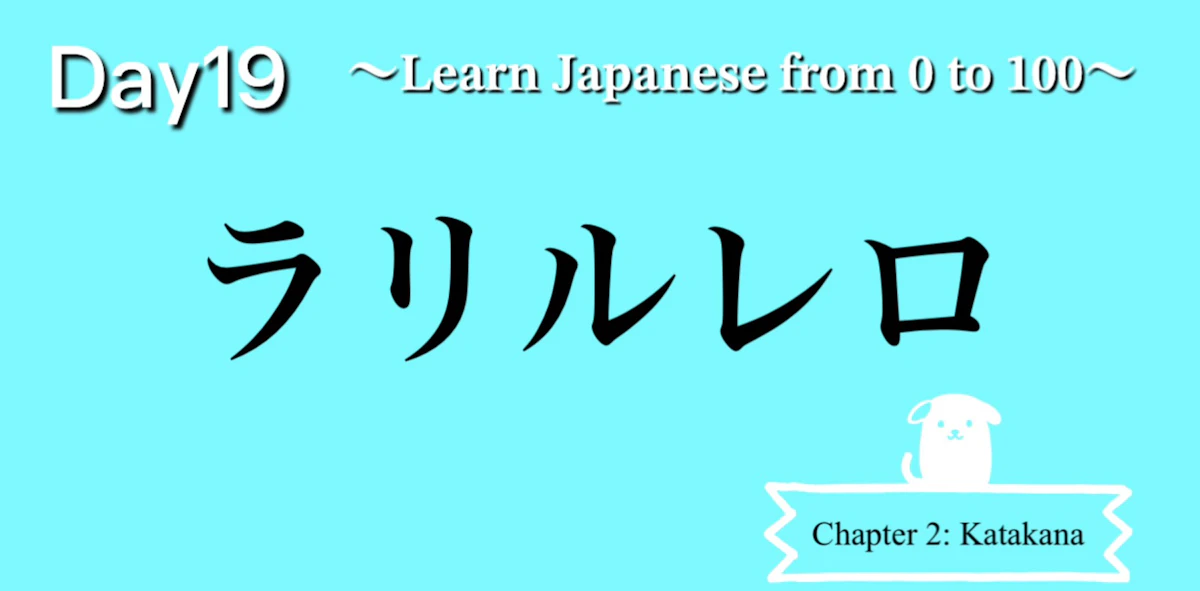
The five R-row katakana — ラ (ra), リ (ri), ル (ru), レ (re), ロ (ro) — appear on ramen signs, robot toys, remote controls, and restaurant menus all across Japan. Learn to recognise and write them today and a whole layer of everyday katakana vocabulary clicks into place immediately.
The Japanese R Sound: Pronunciation Guide
The Japanese R is a single, light tap of the tongue tip against the alveolar ridge — the small bump just behind your upper front teeth. Think of the quick "d" in American English butter, or the brief flap in British English ladder. The contact lasts a fraction of a second; the tongue bounces off and immediately releases.
Katakana | Romaji | Pronunciation |
|---|---|---|
ラ | ra | tap-R + "ah" as in father |
リ | ri | tap-R + "ee" as in see |
ル | ru | tap-R + "oo" as in rule |
レ | re | tap-R + "eh" as in red |
ロ | ro | tap-R + "oh" as in row |
All five use the same light alveolar tap — only the vowel changes. These sounds are identical to the hiragana R-row. If you have already worked through the hiragana らりるれろ guide, the pronunciation is already in your ears; katakana ラリルレロ are simply the printed forms those same syllables take in foreign loanwords, brand names, and emphasis writing.
Cultural note: Listen to any Japanese speaker order ラーメン (rāmen) and you'll hear the soft tap instantly — no curl, no roll, just a brief forward flick. Matching that lightness makes your katakana reading sound natural to Japanese ears from the very first word.
Mnemonics: A Visual Hook for Each Character
A reliable mnemonic connects the shape of a character to its sound. Use these until recognition becomes automatic — trace the character while saying the image aloud, and the shape and sound fuse together quickly.
ラ (ra) — Picture someone throwing their arm back and shouting "RA!" as a battle cry. The short top stroke is the arm flying outward; the longer angled stroke below is the body following through. Shout it: RA!
リ (ri) — Two ri-ver reeds standing side by side on a riverbank. Both strokes are short and upright, like reeds rising from water. Say "ri-ver reeds" as you trace them.
ル (ru) — The shape curves like a rooster's neck bending forward to peck at the ground. Follow that long sweeping tail at the lower right — it's the rooster looking for seeds. Say "ru-ooster."
レ (re) — One bold sweeping stroke, like signing a receipt in a single confident motion. Quick, flowing, done. Say "re-ceipt."
ロ (ro) — A closed square box, like looking down into a small room from above. Four walls, no openings. Say "ro-om."
Stroke Order for ラリルレロ
Correct stroke order keeps your handwriting balanced and legible. The guiding rule across katakana — as you saw studying the サシスセソ row — is top-to-bottom, left-to-right.
ラ — 2 strokes 1. Short horizontal stroke from left to right across the top. 2. Start just below the midpoint of stroke 1; angle down-left, then curve down and sweep to the right.
リ — 2 strokes 1. Short diagonal stroke angling down-right, with a small hook or upward flick at the bottom. 2. A slightly longer, nearly vertical stroke to the right of stroke 1, also ending with a small upward flick.
ル — 2 strokes 1. A stroke going straight down with a small rightward hook at the bottom. 2. A stroke starting at the upper right, curving down and sweeping outward to the right in a long open tail.
レ — 1 stroke 1. Start upper-left; angle downward; then turn and sweep upward-right in a long rising curve — like a confident, swooping tick mark.
ロ — 3 strokes 1. Short horizontal stroke across the top. 2. Left side and bottom: a stroke going straight down, then continuing along the base (an inverted-L shape). 3. Right side: a vertical stroke going down to complete the box.
Writing tip: Keep ロ close to a square — a tall rectangle is the most common shape error beginners make. For a quick shape-contrast exercise, compare the closed box of ロ with the open angles in the タチツテト row. Recognising open versus closed shapes is a reliable speed-reading shortcut throughout all of katakana.
Vocabulary and Example Sentences
Core vocabulary — read each word aloud using your tap-R:
Katakana | Romaji | English Meaning |
|---|---|---|
ラーメン | rāmen | ramen (noodle soup) |
リンゴ | ringo | apple |
ルール | rūru | rule |
レストラン | resutoran | restaurant |
ロボット | robotto | robot |
ラジオ | rajio | radio |
リモコン | rimokon | remote control |
ルーム | rūmu | room |
レモン | remon | lemon |
ロケット | roketto | rocket |
Say the list top-to-bottom, then bottom-to-top, as a pronunciation drill. All ten words use the same soft tap — only the vowel and surrounding sounds change.
Example sentences — read each aloud before checking the English:
- ラーメンがすきです。 Rāmen ga suki desu. I like ramen.
- リンゴをください。 Ringo o kudasai. An apple, please.
- これはルールです。 Kore wa rūru desu. This is a rule.
- レストランにいきます。 Resutoran ni ikimasu. I'm going to the restaurant.
- リモコンはどこですか。 Rimokon wa doko desu ka. Where is the remote control?
Sentences 1–3 are ideal for pronunciation drilling — each has a clear, single R-row word in the spotlight.
Common Mistakes Learners Make with ラリルレロ
Curling the tongue for an English "R" This is the most frequent error. English speakers (especially those with a North American accent) instinctively pull the tongue back and curl it for "R." The Japanese tap is forward in the mouth — tongue tip touching the ridge behind the upper teeth, no curl, no tension. If your R sounds heavy or deep, relax and bring the tongue forward.
Substituting "L" for the tap Learners sometimes slide into an "L" — saying lāmen for ラーメン. The mouth position for Japanese R and English L are similar, but the English L involves a full contact and hold; the Japanese R is one brief bounce. Keep the contact shorter than you think you need to.
Confusing リ and ル when reading Both characters have two strokes and lean to the right. The key difference is the tail: リ has two strokes of roughly equal length, both ending in small upward flicks. ル has a dramatically longer right stroke that curves downward and sweeps outward in a broad tail. Ask yourself: is there a long, sweeping tail? Yes → ル. No → リ.
Making ロ round instead of square Because "ro" ends in a round-sounding vowel, learners sometimes draw ロ as an oval or circle. It must be an angular, nearly square box with straight sides — not a rounded O shape.
Dropping the long-vowel mark Writing ラメン instead of ラーメン is a common slip. The elongation dash ー doubles the preceding vowel and is an essential part of the word's spelling. Omitting it changes the word just as surely as changing a letter would.
Ready to get real-time feedback on your pronunciation? Start your Free Trial lesson with a Japanese teacher over LINE — your tutor can listen to your R-row out loud and give you instant, specific corrections in a one-on-one setting.
Practice Quiz
Try each section before opening the answers.
Part 1 – Read the Katakana
Show answers | # | Katakana | Reading | |---|----------|---------| | 1 | ラ | ra | | 2 | リ | ri | | 3 | ル | ru | | 4 | レ | re | | 5 | ロ | ro |
Part 2 – Write the Katakana
Show answers | # | Romaji | Katakana | |---|--------|----------| | 6 | ra | ラ | | 7 | ri | リ | | 8 | ru | ル | | 9 | re | レ | | 10 | ro | ロ |
Part 3 – Translate the Words
Show answers | # | Word | Answer | |---|------|--------| | 11 | ラーメン | rāmen — ramen noodle soup | | 12 | リンゴ | ringo — apple | | 13 | ルール | rūru — rule | | 14 | レストラン | resutoran — restaurant | | 15 | ロボット | robotto — robot |
FAQ
Is the Japanese R the same sound as the Spanish R?
Not quite. Spanish has a single tap (as in pero) and a sustained trill (as in perro). The Japanese R matches the single-tap version — one brief contact with the alveolar ridge, never a trill. If Spanish is your native language, you likely already make the correct movement instinctively; just be careful never to trill.
Do ラリルレロ sound different from らりるれろ?
No — the sounds are completely identical. Katakana and hiragana represent the same spoken syllables; the scripts differ only by usage context. Katakana marks foreign loanwords, brand names, and emphasis; hiragana carries native Japanese words and grammatical particles. Knowing either script's R-row means you instantly know the other's.
What is the easiest way to tell ル and ロ apart at a glance?
Check for closure. ロ is a fully enclosed box — four sides with no openings. ル is open on the right; the bottom stroke sweeps outward and the shape never closes. A quick mental test: could you trap air inside that shape? If yes, it is ロ. If it opens out, it is ル.
Why do Japanese loanwords add extra vowels to English words?
Japanese phonology only permits a syllable to end in a vowel (or the special nasal ン). English robot becomes ロボット (robotto) because each consonant cluster that Japanese phonology cannot support gets a vowel inserted after it. Recognising this consistent adaptation pattern makes decoding katakana loanwords much faster with practice.
Continue Learning
- ← Previous lesson: Katakana ヤユヨ — the Y-row characters
- → Next lesson: Katakana ワヲン — the W-row and the syllabic N
This article is Lesson 19 of the Kind Japanese 100-day beginner curriculum.

