
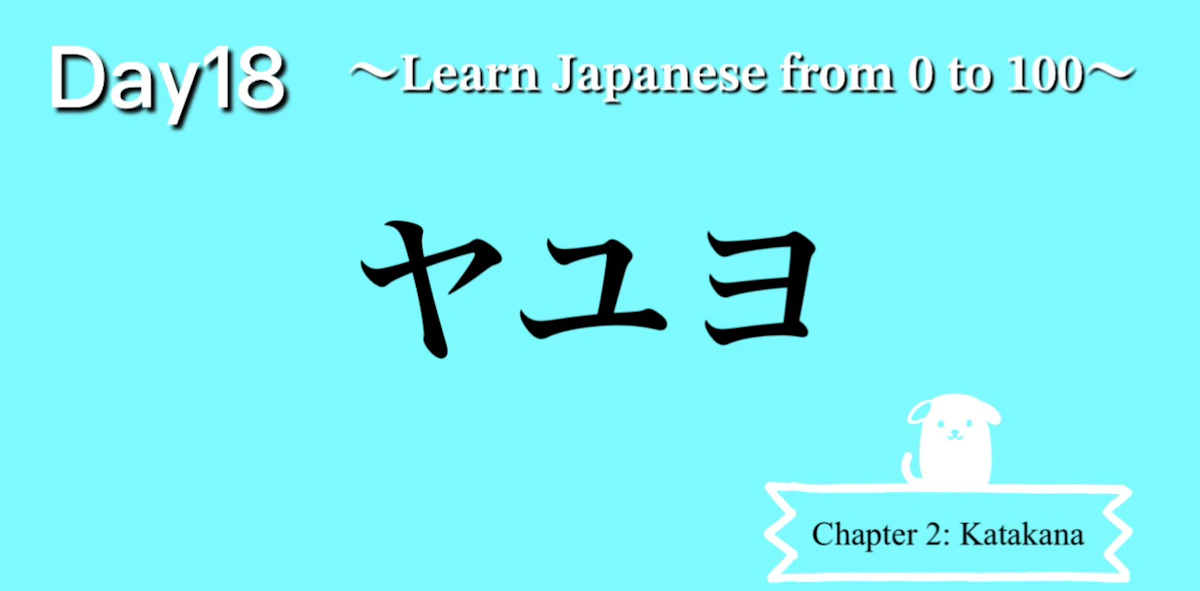
The Three Y-Row Characters at a Glance
ヤ (ya), ユ (yu), and ヨ (yo) share their sounds exactly with their hiragana equivalents — if you have already studied hiragana ya-yu-yo (やゆよ), the pronunciation is already in your head. What is new here is the shape.
Katakana | Romaji | Pronunciation guide | Hiragana |
|---|---|---|---|
ヤ | ya | like "ya" in "yard" | や |
ユ | yu | like "you" | ゆ |
ヨ | yo | like "yo" in "yoga" | よ |
All three are short, clean syllables. Keep them flat — no rising or falling tone, no stress on any part of the sound. Ya, yu, yo — smooth and even every time.
How to Write ヤ, ユ, and ヨ
Learning the correct stroke order now prevents bad habits that are genuinely hard to unlearn later. Trace each character several times as you read these descriptions.
ヤ — 2 strokes 1. A short diagonal stroke from upper-left down toward the right. 2. A longer vertical stroke that crosses the first stroke and continues downward, with a small flick to the left at the bottom.
The key to ヤ: the second stroke is longer and dominant. The first stroke is the shorter one, sitting above and to the left of the crossing point.
ユ — 3 strokes 1. A short horizontal stroke at the top (left to right). 2. A curved stroke on the right side that arcs slightly inward and downward. 3. A longer horizontal stroke at the bottom (left to right).
Keep both horizontal strokes genuinely horizontal. If they tilt, ユ quickly becomes hard to distinguish from ツ (tsu) — the most common confusion in all of katakana.
ヨ — 3 strokes 1. Top horizontal stroke, with a short vertical connector dropping from its right end. 2. Middle horizontal stroke extending to the left from that connector. 3. Bottom horizontal stroke extending slightly further left than the middle one.
ヨ is three evenly-spaced horizontal bars connected on the right side by a vertical line. Every bar must be straight — curved ヨ is one of the most common handwriting errors at this stage.
Memory Tricks That Actually Work
Visual mnemonics dramatically speed up katakana retention. Here are three that stick with learners.
ヤ → YAk horns The two crossing strokes of ヤ look like the horns of a yak — the shaggy-haired animal of the Himalayas — seen head-on. Every time you see ヤ, picture a yak staring straight at you.
ユ → YOU ユ looks like the letter "U" with a lid across the top. It sounds exactly like the English word you. Picture yourself pointing at someone and saying "YOU" — the ユ shape frames that gesture perfectly.
ヨ → YOga shelf ヨ looks like a bookshelf viewed from the side — three horizontal planks stacked evenly. Picture someone holding a yoga pose beside their three-shelf bookcase. Three shelves, one syllable: yo.
Essential Vocabulary: ヤ, ユ, ヨ in Real Loanwords
Katakana is the script for foreign loanwords, so these three characters appear constantly in daily Japanese — on menus, apps, product labels, and street signs. The words below are all high-frequency and worth memorising now.
Katakana | Romaji | English meaning |
|---|---|---|
ヤード | yādo | yard (unit of length) |
ヤクルト | Yakuruto | Yakult (brand name) |
ユニフォーム | yunifōmu | uniform |
ユーザー | yūzā | user |
ユニバーサル | yunibāsaru | universal |
ユーモア | yūmoa | humor |
ユーロ | yūro | euro (currency) |
ヨガ | yoga | yoga |
ヨット | yotto | yacht |
ヨーロッパ | Yōroppa | Europe |
ヨーグルト | yōguruto | yogurt |
Cultural note: Notice how many ヨ words connect to Europe — ヨーロッパ (Europe), ユーロ (euro), and ヨーグルト (yogurt, which entered Japanese via European languages). The Y-row has an unexpectedly European flavour in modern Japanese vocabulary, which makes it easier to remember once you spot the pattern.
Example Sentences in Context
Reading characters in isolation builds recognition; reading them in sentences builds real fluency. Work through each of these aloud:
- 毎朝ヨガをします。 Mai asa yoga o shimasu. I do yoga every morning.
- ヨーロッパに行きたいです。 Yōroppa ni ikitai desu. I want to go to Europe.
- このユーザーは新しいです。 Kono yūzā wa atarashii desu. This user is new.
- ユニフォームを着ています。 Yunifōmu o kite imasu. I am wearing a uniform.
- ヨットで海に出ました。 Yotto de umi ni demashita. We went out to sea on a yacht.
Can you spot every Y-row katakana character in each sentence? If a word slows you down, return to the vocabulary table and trace the characters a few more times before moving on.
Common Mistakes with ヤ, ユ, and ヨ
Mixing up ユ and ツ — the single most common katakana error Both characters pack two or three strokes into a small space, making them look alike at a glance. The difference is stroke angle: ユ (yu) has horizontal strokes — like shelves — while ツ (tsu) has short diagonal strokes that angle down to the right, like raindrops. If you ever write ユ and the strokes start tilting, you have written ツ. Practice them side by side; the katakana SA-row lesson covering サシスセソ includes ツ in context and is a useful companion for this comparison.
Confusing ヨ with ラ Learners sometimes blur ヨ (yo) and ラ (ra) because both feature horizontal elements. The distinction is clear once you look: ヨ has three straight horizontal bars with a vertical connector on the right, while ラ ends in a distinctive sweeping curve that goes down and to the left. You will meet ラ directly in the next lesson — keeping this contrast in mind now saves confusion later.
Dropping the long-vowel mark (ー) Words like ユーザー and ヨーグルト require the katakana long-vowel dash (ー). Omitting it produces an incorrect or unrecognisable form. Make it a habit: whenever you see ー, hold the preceding vowel sound for one extra beat when reading aloud.
Over-curving ヨ The three bars of ヨ are straight lines — not wavy, not rounded. Learners accustomed to more rounded scripts often soften ヨ until it no longer reads clearly. Straight lines only, always.
Practice Quiz
Cover the answer table, then test yourself on each question.
① Read — Katakana → Romaji
# | Katakana | Your answer |
|---|---|---|
1 | ヤ | ? |
2 | ユ | ? |
3 | ヨ | ? |
② Write — Romaji → Katakana
# | Romaji | Your answer |
|---|---|---|
4 | ya | ? |
5 | yu | ? |
6 | yo | ? |
③ Words — Read the full word
# | Katakana | Your answer |
|---|---|---|
7 | ヨガ | ? |
8 | ユニフォーム | ? |
9 | ヨーロッパ | ? |
10 | ユーザー | ? |
Answers
# | Answer |
|---|---|
1 | ya |
2 | yu |
3 | yo |
4 | ヤ |
5 | ユ |
6 | ヨ |
7 | yoga |
8 | yunifōmu |
9 | Yōroppa |
10 | yūzā |
Scored 10/10? You are ready for the next row. If any answer was uncertain, go back to the mnemonics, trace the characters, and run the quiz once more before moving on.
FAQ
Are the sounds of ヤ, ユ, ヨ identical to hiragana や, ゆ, よ?
Yes — pronunciation is exactly the same. Katakana and hiragana represent identical syllables; the script you choose depends on the type of word, not the sound. Because the pronunciation is already familiar from hiragana, your main task with these katakana characters is learning to recognise and write the new shapes.
Why do ユ and ツ look so similar?
Both characters have two or three closely-packed strokes of similar length. The critical difference is orientation: ユ's strokes are horizontal, and ツ's strokes are diagonal and angled downward to the right. Writing both characters many times in direct comparison — not in isolation — is the fastest way to lock in the distinction permanently.
Do small versions of ヤ, ユ, ヨ exist in katakana?
Yes. Small ャ, ュ, and ョ combine with consonant characters to form compound sounds, exactly as in hiragana — for example, キャ (kya), ミュ (myu), and ショ (sho). These combinations appear constantly in loanwords, so you will encounter them frequently as soon as you start reading real katakana text.
Which ヤ, ユ, or ヨ word is most useful to learn first?
Start with words already familiar to you in English: ヨガ (yoga), ユーザー (user), and ヨーグルト (yogurt) are immediately recognisable and give you instant reading wins. Spotting a known word written in a new script is one of the most effective confidence-builders in early language learning.
Ready to get real-time feedback on your katakana reading and writing? One-on-one practice with a teacher catches the small errors — a slightly tilted ユ, a missing ー — that self-study easily misses. Start your Free Trial lesson over LINE and put ヤ, ユ, ヨ to work in an actual conversation.
Continue Learning
- ← Previous lesson: Katakana MA-row — マ ミ ム メ モ
- → Next lesson: Katakana RA-row — ラ リ ル レ ロ
This is Lesson 18 of the Kind Japanese 100-day beginner curriculum.

