
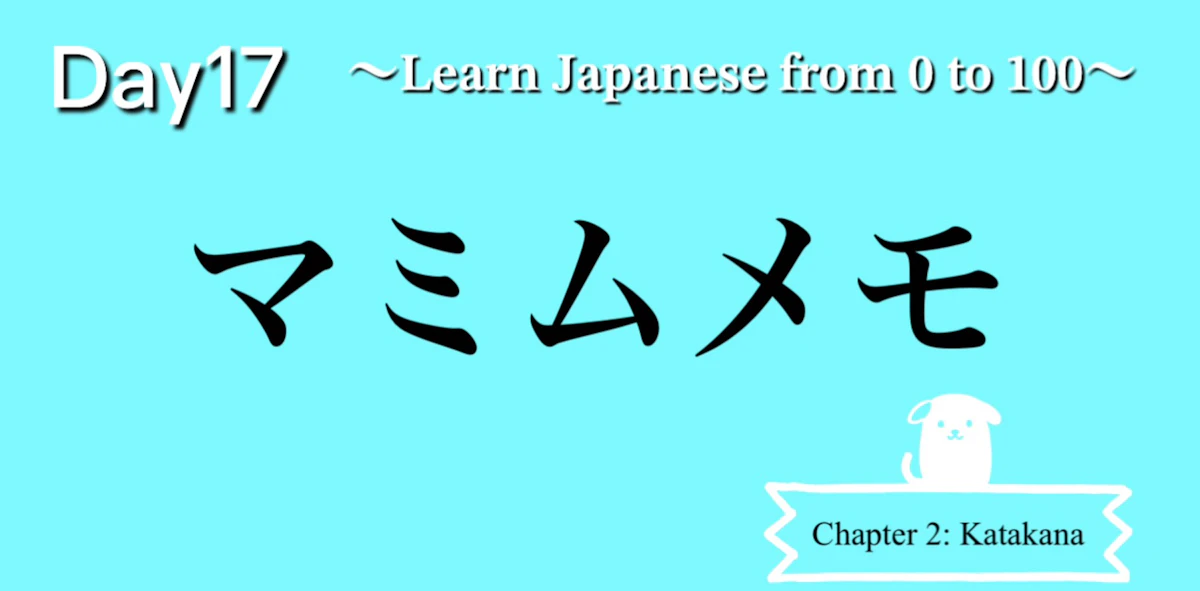
Five characters stand between you and an entire row of katakana — the MA row: マ、ミ、ム、メ、モ. They appear constantly in everyday Japanese loanwords: the coffee-shop menu (メニュー), the gym schedule (マラソン), the movie poster (ムービー). Master these five shapes today and you will start recognising them everywhere you look.
The Five Characters at a Glance
Each character in the MA row shares its pronunciation exactly with the hiragana equivalent — the only difference is the script and when it is used. Katakana appears in loanwords, foreign names, onomatopoeia, and emphasis; hiragana handles native Japanese words and grammar particles.
Katakana | Hiragana | Romaji | Sound guide | Stroke count |
|---|---|---|---|---|
マ | ま | ma | "mah" as in mama | 3 |
ミ | み | mi | "mee" as in meet | 3 |
ム | む | mu | "moo" as in moon | 2 |
メ | め | me | "meh" as in mellow | 2 |
モ | も | mo | "moh" as in more | 3 |
The sounds are identical to those you studied in the hiragana MA row guide. If those hiragana shapes are already solid, you already own the pronunciation — you just need to attach it to a new set of shapes.
Stroke Order: How to Write マミムメモ
Katakana is built from straight lines and sharp angles. Writing each character in the correct stroke order builds the muscle memory that makes reading faster. Follow the descriptions below and keep your strokes clean and angular — if the shapes look rounded or flowing, you are slipping back into hiragana.
マ (ma) — 3 strokes 1. Horizontal line, left to right 2. Diagonal line slanting down-right, crossing stroke 1 3. Curved hook from the crossing point, curving down and to the left
ミ (mi) — 3 strokes 1. Short horizontal line at the top 2. Slightly longer horizontal line in the middle 3. Longer, slightly angled horizontal line at the bottom
ム (mu) — 2 strokes 1. Short diagonal/curved stroke moving right, curving slightly down 2. A larger curved stroke that wraps around like a closing enclosure, ending with a small uptick
メ (me) — 2 strokes 1. Diagonal line from upper-left to lower-right 2. Crossing diagonal from upper-right, passing over stroke 1 and ending with a small hook
モ (mo) — 3 strokes 1. Horizontal line at the top 2. Longer horizontal line in the middle 3. Vertical line passing through both horizontals, curving into a hook at the bottom
Key tip: Write モ in the order horizontal → horizontal → vertical, not vertical first. Getting stroke order right from the start saves you from relearning later.
Mnemonics for Every Character
Mnemonics are the fastest bridge from "I keep forgetting which is which" to instant recognition. One reliable mental image per character is all you need.
マ (ma) — Picture a capital M with one leg raised into a kick, plus a trailing hook. The shape echoes the letter that starts the sound. マ = M-kick = ma.
ミ (mi) — Three horizontal lines stacked up, like three musical notes. Think of the solfège scale: do, re, mi. The three stripes cue the sound. ミ = three musical lines = mi.
ム (mu) — The shape resembles a cow's open mouth, ready to moo. Say "moo!" and picture ム as that open, rounded jaw. ム = cow mouth = mu.
メ (me) — メ looks like an X crossing over an eye. The Japanese word for eye is 目 (me). The character is practically pointing at itself. メ = eye X = me.
モ (mo) — Two horizontal bars and a hooked vertical — like the letter F given more structure. モ = more bars = mo.
Loanword Vocabulary Using マミムメモ
The MA row is a workhorse across Japanese loanword vocabulary. Here are 17 high-frequency words you will encounter early and often — scan the table, say each word aloud, and notice how naturally the katakana maps onto the English original.
Katakana | Romaji | English |
|---|---|---|
マップ | mappu | map |
マスク | masuku | mask |
マラソン | marason | marathon |
マナー | manaa | manners / etiquette |
マシン | mashin | machine |
マネージャー | maneejaa | manager |
ミルク | miruku | milk |
ミステリー | misuterii | mystery |
ミュージック | myuujikku | music |
ムービー | muubii | movie |
メニュー | menyuu | menu |
メッセージ | messeiji | message |
メダル | medaru | medal |
メモ | memo | memo / note |
モデル | moderu | model |
モバイル | mobairu | mobile |
モンスター | monsutaa | monster |
Cultural note: メモ (memo, "note") has become so deeply woven into everyday Japanese life that native speakers use it completely naturally. When a colleague says メモして (memo shite, "jot that down"), it feels no more foreign than "coffee" does in English — a reminder that katakana loanwords often become fully naturalised after a generation of use.
In real texts, MA-row characters combine with rows you have already covered. Words like マスタード (masutaado, mustard) blend the MA row with the katakana SA row, while compound words like モーターサイクル (mootaasaikuru, motorcycle) reach across to characters from the katakana TA row. These cross-row connections start to click fast once your vocabulary grows.
Example Sentences in Context
Reading katakana in isolation is one skill; reading it inside real sentences is another. These five examples put MA-row words to work in situations a beginner will actually encounter.
- ミルクをください。
Miruku o kudasai.
Please give me some milk. - メニューを見てもいいですか?
Menyuu o mite mo ii desu ka?
May I look at the menu? - マラソンは42キロです。
Marason wa yonjuuni kiro desu.
A marathon is 42 kilometres. - メッセージを送ってください。
Messeiji o okutte kudasai.
Please send me a message. - このモデルはとても人気があります。
Kono moderu wa totemo ninki ga arimasu.
This model is very popular.
Common Mistakes
Mixing up マ (ma) and ム (mu) Learners often confuse these two because both have curved elements. The key distinction: マ is wide and open, with its hook sweeping left; ム is smaller and closed, wrapping in on itself like a little enclosure. Write them side by side ten times until the difference lives in your hand, not just your head.
Confusing ミ (mi) with the kanji 三 ("three") Both consist of three horizontal lines, which trips up many learners. In ミ, the lines progressively widen toward the bottom and the lowest line is angled; in 三, the lines are more even and level. Context is also a reliable guide — ミ only appears in katakana loanwords and foreign names, never where the number three would be written.
Making メ (me) too round After spending time with hiragana め, learners often carry over the rounded, looping style into katakana. Keep both diagonal strokes in メ straight and sharp. The crossing should be angular, not curving. If your メ looks like a rounded figure-eight, slow down and focus on the lines.
Wrong stroke order in モ (mo) The instinct is often to draw the vertical line first. The correct sequence is: top horizontal → middle horizontal → vertical with hook. Incorrect stroke order does not just slow you down — it subtly changes the shape of the finished character and can make it harder to read at speed.
Practice Quiz
Cover the answer column, write your responses, then check below.
Part 1 — Read the Katakana
# | Katakana | Your reading |
|---|---|---|
1 | マ | ? |
2 | ミ | ? |
3 | ム | ? |
4 | メ | ? |
5 | モ | ? |
Part 2 — Write the Katakana
# | Romaji | Your katakana |
|---|---|---|
6 | ma | ? |
7 | mi | ? |
8 | mu | ? |
9 | me | ? |
10 | mo | ? |
Part 3 — Translate the Loanwords
# | Word | English meaning |
|---|---|---|
11 | マスク | ? |
12 | ミルク | ? |
13 | ムービー | ? |
14 | メニュー | ? |
15 | モデル | ? |
Answers
# | Answer |
|---|---|
1 | ma |
2 | mi |
3 | mu |
4 | me |
5 | mo |
6 | マ |
7 | ミ |
8 | ム |
9 | メ |
10 | モ |
11 | mask |
12 | milk |
13 | movie |
14 | menu |
15 | model |
FAQ
Is the pronunciation of the katakana MA row different from hiragana?
No — マ、ミ、ム、メ、モ are pronounced exactly like ま、み、む、め、も. The sounds are identical; only the script and its usage differ. Katakana can feel slightly crisper on the page, but your mouth makes the same shapes regardless of which script you are reading.
How do I stop confusing ミ (mi) and the kanji 三?
Look at the angles: ミ has lines that grow wider and tilt downward toward the bottom, while 三 has three roughly equal, level lines. More practically, context almost always settles it — ミ appears only in katakana loanwords and foreign names, never in a numerical context where 三 would be used.
Why does Japanese use katakana specifically for foreign loanwords?
Katakana signals foreign origin at a glance, letting readers instantly identify borrowed vocabulary within a mixed-script sentence. It functions similarly to italicising a foreign phrase in English — a visual marker that says "this word came from elsewhere." Over time, many loanwords feel completely native even while keeping their katakana.
How many basic katakana characters are there in total?
There are 46 basic katakana characters, mirroring the 46 hiragana characters exactly. The MA row covers five of those 46. Once you have worked through all the rows — and the small set of combination characters — you can decode any katakana text, including the vast number of English-origin loanwords used in daily Japanese life.
Continue learning
Before moving forward, make sure the katakana HA row (ハヒフヘホ) feels solid — those characters appear alongside MA-row katakana in a lot of common vocabulary. When you are ready, head on to the katakana YA row (ヤユヨ) to continue filling in your katakana chart.
Once katakana feels natural on the page, the fastest way to turn that reading skill into real spoken Japanese is to practise with a native teacher. Start your Free Trial one-on-one lesson over LINE and put マミムメモ — and every other character you have learned — to work in an actual conversation.
This is Lesson 17 of the Kind Japanese 100-day beginner curriculum.

