
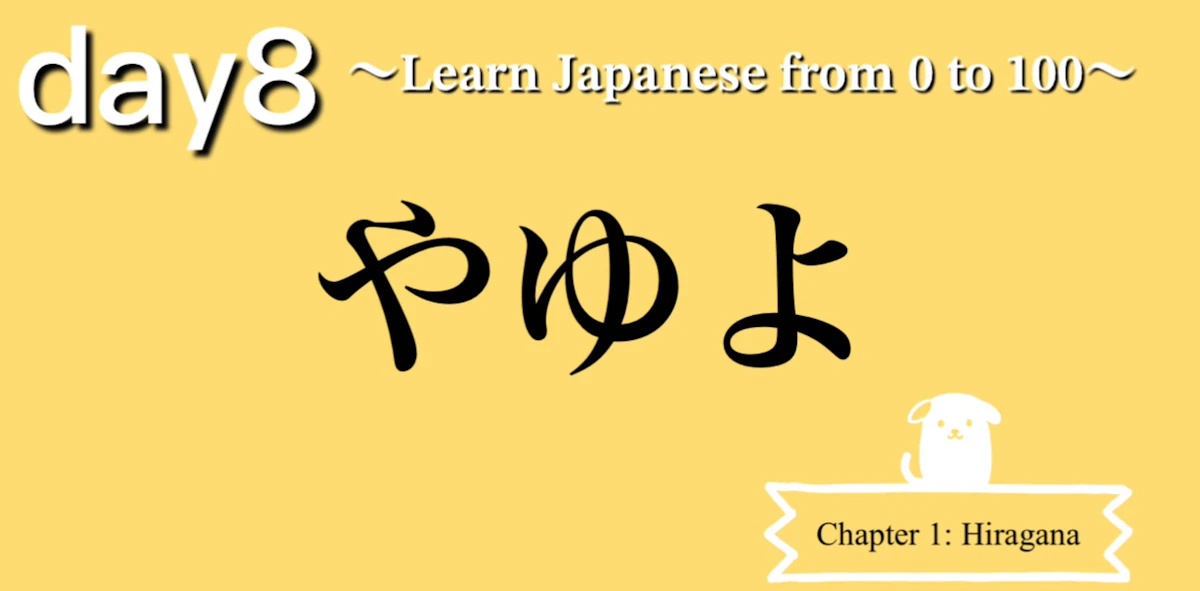
The Y-row of hiragana contains just three characters — や (ya), ゆ (yu), and よ (yo) — but they are among the most versatile in the entire syllabary. Not only do they appear throughout everyday vocabulary, they serve as the building blocks for the combination sounds (拗音, yōon) that unlock blended syllables like きゃ, しゅ, and ちょ. Master these three, and a significant portion of the hiragana system snaps into place.
New to hiragana entirely? Start with the five core vowel sounds — あ, い, う, え, お before continuing here, as everything in the Y-row extends from that vowel foundation.
The Three Y-Row Characters at a Glance
Hiragana | Romaji | Pronunciation | Memory mnemonic |
|---|---|---|---|
や | ya | "yah" — open and bright | や looks like a yard gate: one post, one angled rail |
ゆ | yu | "you" — lips slightly rounded | ゆ resembles a fish curling its tail to say "you" |
よ | yo | "yo" — short, like the first beat of "yo-yo" | よ has two horizontal lines like a yo-yo string mid-spin |
Mnemonics are personal — if yours is different, trust it. The goal is to give your brain a visual anchor that makes the shape stick before repetition alone can do the job.
Pronunciation: Getting Ya, Yu, Yo Right
や (ya) sounds exactly like the English exclamation "yah." Open your mouth, let the Y glide forward, and keep the vowel short. Nothing tricky here.
ゆ (yu) rhymes with the English word "you." Round your lips gently, but avoid an "ew" drift — the Japanese ゆ is cleaner and more forward in the mouth.
よ (yo) is the first beat of "yo-yo," nothing more. Keep it short and clear. The lengthened form is よう (yō), written with a following う, and the difference in length changes word meaning entirely.
One thing worth knowing if you have already studied the か-row consonants (か, き, く, け, こ): the Y in Japanese is a smooth glide, not a hard stop. Do not over-aspirate — keep it relaxed and flowing.
Stroke Order: How to Write や, ゆ, and よ
Getting stroke order right from the start prevents habits that are surprisingly difficult to un-learn.
や (ya) — 3 strokes 1. A curved horizontal line running from left to right (the top of the character). 2. A descending stroke that crosses the first line and finishes with a small leftward hook at the bottom. 3. A short diagonal stroke at the lower right, separate from the vertical.
ゆ (yu) — 3 strokes 1. The left arc: begin at the upper centre, curve left, sweep downward and back to the right, ending below the starting point. 2. A short horizontal line to the right of the arc, at mid-height. 3. A second short horizontal line directly below the first.
よ (yo) — 2 strokes 1. A short horizontal stroke at the top, curving gently downward at the right end. 2. A second stroke that starts horizontal from the left, then bends into a downward vertical at the right.
For animated stroke-order demonstrations, search "や stroke order" on YouTube or use a free practice app such as Kakugo or Obenkyo. Watching the stroke animate a few times before you pick up your pen is consistently more effective than copying a static image.
Vocabulary: Ya, Yu, Yo in Everyday Japanese
Here are twelve high-frequency words to get you reading these characters in real context. Read each word, cover the romaji, and test yourself before checking.
Japanese | Romaji | English |
|---|---|---|
やま | yama | mountain |
やさしい | yasashii | kind, gentle |
やすみ | yasumi | rest, day off, holiday |
やきとり | yakitori | grilled chicken skewers |
ゆき | yuki | snow |
ゆっくり | yukkuri | slowly, at a relaxed pace |
ゆめ | yume | dream |
ゆうべ | yūbe | last night |
よる | yoru | night |
ようこそ | yōkoso | welcome |
よい | yoi | good (slightly formal) |
よやく | yoyaku | reservation, booking |
Cultural note: ようこそ (yōkoso) is one of the first words you will hear when entering any Japanese shop, restaurant, or home. It is more than a greeting — it is an expression of おもてなし (omotenashi), Japan's deep-rooted culture of wholehearted hospitality. When a host says yōkoso, they are genuinely committing to your comfort.
Example sentences
- やまが きれいです。 Yama ga kirei desu. The mountain is beautiful.
- ゆっくり はなして ください。 Yukkuri hanashite kudasai. Please speak slowly.
- よる、ほしが みえます。 Yoru, hoshi ga miemasu. At night, you can see the stars.
- ゆきが ふって います。 Yuki ga futte imasu. It is snowing.
- ようこそ、にほんへ! Yōkoso, Nihon e! Welcome to Japan!
Read each sentence aloud three times, then once at natural speed. The gap between decoding and fluency closes fastest through voicing, not just recognising.
Y-Row Combination Sounds (拗音 — Yōon)
This is where や, ゆ, よ become genuinely powerful. When written in a small form — ゃ, ゅ, ょ — and placed after an い-column kana, they fuse into a single syllable called a yōon (拗音). Two characters become one beat.
How it works: き (ki) + ゃ = きゃ (kya) — one syllable, not two.
Base kana | + ゃ | + ゅ | + ょ |
|---|---|---|---|
き (ki) | きゃ kya | きゅ kyu | きょ kyo |
し (shi) | しゃ sha | しゅ shu | しょ sho |
ち (chi) | ちゃ cha | ちゅ chu | ちょ cho |
に (ni) | にゃ nya | にゅ nyu | にょ nyo |
ひ (hi) | ひゃ hya | ひゅ hyu | ひょ hyo |
み (mi) | みゃ mya | みゅ myu | みょ myo |
り (ri) | りゃ rya | りゅ ryu | りょ ryo |
ぎ (gi) | ぎゃ gya | ぎゅ gyu | ぎょ gyo |
じ (ji) | じゃ ja | じゅ ju | じょ jo |
び (bi) | びゃ bya | びゅ byu | びょ byo |
ぴ (pi) | ぴゃ pya | ぴゅ pyu | ぴょ pyo |
A quick real-world example: 東京 (Tōkyō, Tokyo) contains きょ inside the second character 京 — the capital city's name is a yōon in action.
When you reach the katakana system, the same logic applies. The katakana Y-row guide covering ヤ, ユ, and ヨ shows you the katakana equivalents of these sounds and how they appear in foreign loanwords.
Common Mistakes Learners Make
Confusing や with め or ぬ All three characters share a broadly similar silhouette in some handwriting styles. The deciding detail is the lower right area: や ends with an open diagonal stroke; め and ぬ both close into loops. Paying attention to whether that corner is open or closed will solve the confusion quickly.
Writing ゆ without two distinct right strokes The right side of ゆ requires two separate short horizontal lines. Learners frequently merge them into one stroke, or omit the second entirely. Slow your hand down on this character until both strokes feel distinct and natural.
Treating small ゃゅょ as two-beat syllables きゃ is one mora, not ki-ya. This matters enormously for rhythm and for sounding natural. Learners who memorised individual kana first often pronounce combination sounds as two beats. Practise clapping the rhythm of words like きゃく (kyaku, guest) and りょこう (ryokō, travel) — one clap per mora — until it feels instinctive.
Confusing よ with よう Standard よ is a short, single-beat vowel. よう is two beats and changes meaning entirely: よい (yoi, good) is not the same word as ようい (yōi, preparation / ready). Always read the full written form before deciding on length.
Accidentally extending ゆ into ゆう When writing by hand, learners sometimes draw the right strokes of ゆ too long, implying a lengthened vowel (ゆう, yū). Keep those two horizontal marks compact. If you intend ゆう, write the extra う explicitly — never let handwriting blur the distinction.
Practice Quiz
Test yourself before moving on. Write or say each answer, then check below.
Part 1 — Single characters
- や = ?
- ゆ = ?
- よ = ?
Part 2 — Words
- やま = ?
- ゆき = ?
- よる = ?
- ようこそ = ?
Part 3 — Combination sounds
- きゃ = ?
- しょ = ?
- りゅ = ?
Answers
- ya
- yu
- yo
- yama
- yuki
- yoru
- yōkoso
- kya
- sho
- ryu
How did you do on Part 3? Combination sounds trip most learners at first — revisit the yōon table above and clap the rhythm of a few words from each row before continuing.
Want to practise reading and writing these characters with immediate, personalised feedback? Start your Free Trial Japanese lesson over LINE with Kind Japanese and get real corrections on your pronunciation and stroke order from your very first session.
FAQ
Is よ always pronounced the same as in "yo-yo"?
Standard よ is always that same short "yo" sound. The variation you will encounter is よう (yō), where a following う lengthens the vowel to two beats. Written text always signals which one is intended — the character itself never changes its base pronunciation, so context will guide you reliably every time.
What is the difference between や and small ゃ?
Full-size や is a standalone syllable: one mora, pronounced "ya." Small ゃ appears after an い-column kana to create a blended syllable — き + ゃ becomes きゃ (kya), one beat rather than two. In Japanese text input on a keyboard, type "xya" or "lya" to produce ゃ. The two characters are visually identical apart from size.
How long does it take to memorise や, ゆ, and よ?
Most learners recognise all three reliably after 20–30 minutes of active study spread over two or three short sessions. The Y-row sticks quickly because each character maps directly to a familiar English sound. Short daily reviews — even five minutes — build lasting retention far more effectively than a single long cramming session.
Do I need to memorise all the combination sounds before moving on?
No. Understanding the logic — small ゃ, ゅ, ょ fuses with the preceding kana into one beat — is enough at this stage. Specific combinations will stick naturally as your vocabulary grows, and each new word reinforces the pattern. Focus on recognition for now; active production follows with exposure.
Continue Learning
← The ま-row hiragana guide (ま, み, む, め, も) — the characters covered just before this lesson
→ The ら-row hiragana guide (ら, り, る, れ, ろ) — the next set to tackle
This article is Lesson 8 of the Kind Japanese 100-day beginner curriculum.

