
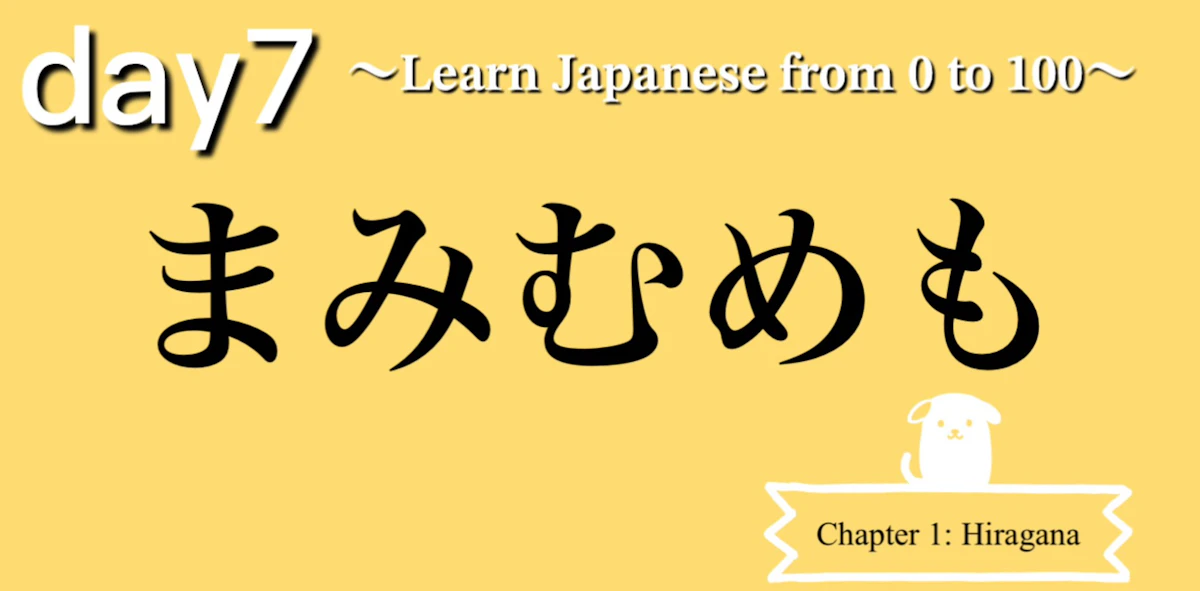
By the end of this guide you will recognise まみむめも on sight, know exactly how to write each character stroke by stroke, and have fifteen real Japanese words ready to use. Let's get into it.
The Ma-Row Characters at a Glance
The five characters below form the ma-row (ま行, ma-gyō) of hiragana — the set of syllables built on the "m" sound. If you have already worked through the a-row (あいうえお) and the ka-row (かきくけこ), the pattern is exactly the same: one consonant, five vowels.
Hiragana | Romaji | Pronunciation Guide | Strokes |
|---|---|---|---|
ま | ma | open "mah" — like "mama" | 3 |
み | mi | clear "mee" — like "meet" without the final t | 2 |
む | mu | soft "moo" — like "moon" without the n | 2 |
め | me | relaxed "meh" — like "met" without the t | 2 |
も | mo | rounded "moh" — like "more" without the r | 3 |
One quick note on む (mu): Japanese lips stay more relaxed than in English. The rounding feels looser than an exaggerated English "moo" — understated, not dramatic.
How to Pronounce まみむめも
Every syllable is a single, equal beat. Japanese is a mora-timed language, meaning no syllable gets stretched or rushed more than any other. Uneven timing is the most common mistake English speakers make in their first weeks.
- ま (ma): Drop your jaw slightly, lips apart. Pure open "ah" vowel — the same sound as the "a" in "father."
- み (mi): Smile lightly, corners of the mouth pulled back. The "ee" vowel is clean and produced at the front of the mouth.
- む (mu): Lips round gently — not tight like English "oo." The jaw stays mostly closed.
- め (me): Mid-mouth "e" sound — similar to "eh" but with the mouth a touch more closed than English speakers usually expect.
- も (mo): Lips round again, slightly more open than む. Think a soft "oh" with no tension.
Pronunciation drill: Say ma – mi – mu – me – mo on one breath, giving each beat equal length. If anything trips you up, it will almost always be む — the relaxed rounding feels unnatural to English speakers at first. Keep it loose.
Stroke Order: Writing まみむめも Correctly
Correct stroke order is not just convention — it builds the muscle memory that makes your handwriting legible and helps each character lodge in your visual memory faster.
ま (ma) — 3 strokes 1. Short horizontal stroke at the top, left to right. 2. Vertical stroke downward from roughly the centre of stroke 1. 3. A curved stroke that begins to the right of the vertical, sweeps right, then curves downward and loops around to the left, finishing below the vertical line.
み (mi) — 2 strokes 1. Short diagonal stroke angling down and slightly to the right (upper area of the character). 2. A longer stroke that starts near the top, sweeps rightward, curves steeply downward, and ends in an upward hook pointing to the right.
む (mu) — 2 strokes 1. A short, slightly curved stroke in the upper-left area. 2. A longer stroke that starts to the right of stroke 1, curves clockwise — rightward, then down and to the left forming a loop — and ends with a small upward flick on the right side.
め (me) — 2 strokes 1. A curved stroke from the upper-left area that angles down and to the right. 2. An almost-closed loop that begins at the top of the first stroke, curves around to form a near-circle, and ends with a tail that exits cleanly to the lower right.
も (mo) — 3 strokes 1. Short horizontal stroke in the upper area. 2. Longer horizontal stroke below the first. 3. A vertical stroke that begins above the second horizontal, passes through it, then curves to the right forming a hook at the bottom.
Writing tip: Ten deliberate repetitions of one character beat one hundred rushed ones every time. Aim to hear the sound in your head as the pen moves.
Mnemonics: One Memory Hook per Character
Mnemonics work best when they are visual and slightly ridiculous. Here is one reliable image for each character.
- ま (ma): Picture a ship's mast — a tall pole (the vertical stroke) with a rope tied in a loop at the bottom (the curving stroke). "MA-st."
- み (mi): The strokes look like a mitten with the thumb sticking out to the right. Imagine humming "mi-mi-mi" while pulling on mittens.
- む (mu): A cow turning its head to the right and saying "MOO!" — む sounds exactly like the start of "moo." The curved tail on the right is the cow's horn.
- め (me): This one almost cheats: め literally means eye (目) in Japanese. The loop is the eyeball; the tail is the eyelid. See an eye, say "me."
- も (mo): Two fishing lines (the horizontal strokes) dangling from a single hook (the curved vertical). You are fishing for more — always mo-re.
The め = eye connection is worth burning in deeply. It is simultaneously your mnemonic and your first vocabulary word.
Ma-Row Vocabulary You Can Use Today
Every word below appears in everyday conversation and on the JLPT N5 vocabulary list. Each one is built from hiragana you have already learned or are learning now.
Japanese | Romaji | English |
|---|---|---|
まえ | mae | front; before |
まど | mado | window |
まいにち | mainichi | every day |
みず | mizu | water |
みち | michi | road; path |
みせ | mise | shop; store |
むし | mushi | insect; bug |
むすめ | musume | daughter |
むずかしい | muzukashii | difficult |
め | me | eye |
めがね | megane | glasses; spectacles |
めいし | meishi | business card |
もり | mori | forest |
もの | mono | thing; object |
もつ | motsu | to hold; to carry |
Cultural note: The word みち (michi / 道) carries weight well beyond "road." The same character 道 (dō) appears in the names of traditional Japanese arts and disciplines — judō, kendō, sadō (the tea ceremony). A "path" in Japanese implies a lifelong practice of refinement. Even as a beginner, you are already on your own みち through the language.
Example Sentences
Read each line aloud — hiragana first, then check the romaji, then the translation.
- まいにち みず を のみます。 Mainichi mizu o nomimasu. I drink water every day.
- まど を あけて ください。 Mado o akete kudasai. Please open the window.
- めがね は どこ ですか? Megane wa doko desu ka? Where are my glasses?
- むすめ は もり で あそびます。 Musume wa mori de asobimasu. My daughter plays in the forest.
- みず を もって きて ください。 Mizu o motte kite kudasai. Please bring water.
Struggling to hear whether your pronunciation is landing correctly? A one-on-one teacher can catch over-rounding on む or a flat め in real time — start a Free Trial lesson on LINE and practise these sentences with live feedback.
Common Mistakes Learners Make with まみむめも
ま vs ほ — the loop confusion Learners frequently mix these two up because both share a curved loop. The reliable distinction: ま has a single vertical stroke running straight down through the centre, with the loop sitting beneath it. ほ is wider and more symmetrical, built from two separate vertical elements side by side. When uncertain, ask: do I see one centre line or two parallel ones?
め vs ぬ — the similar circles Both characters feature an almost-closed loop with a tail, and beginners often swap them. The difference is in the tail: め ends cleanly to the lower right, while ぬ (which you encountered in the na-row hiragana lesson) adds an extra inner curl or swirl before the tail emerges. Holding the two characters side by side and identifying that curl is the fastest way to train the distinction.
む written too flat Learners often flatten む into something resembling an angular "3" or a loose squiggle, missing the deliberate clockwise loop in stroke 2. Without the loop closing properly, む becomes unreadable. Slow down specifically on this character until the loop feels natural.
Rushing み's hook The upward hook at the end of み's second stroke is essential. Drop it, and み starts to look like an incomplete め. Lift the pen upward at the end of stroke 2 — don't just stop or trail leftward.
Test Yourself: Quick Quiz
Part 1 — Read the character
Look at each hiragana and write or say the romaji:
- む = ?
- め = ?
- ま = ?
- も = ?
- み = ?
Part 2 — Read the word
Transliterate into romaji and give the English meaning:
- みず = ?
- もり = ?
- まど = ?
- むし = ?
- めがね = ?
Answers
Part 1: 1. mu 2. me 3. ma 4. mo 5. mi
Part 2: 1. mizu / water 2. mori / forest 3. mado / window 4. mushi / insect 5. megane / glasses
Once you are comfortable with these five hiragana characters, the same sounds reappear in katakana as マ・ミ・ム・メ・モ. When you are ready to add the second script, the katakana ma-row guide (マミムメモ) covers the katakana versions side by side.
FAQ
How is む (mu) different from the English word "moo"?
Japanese む is similar but shorter and less rounded. The lips do not protrude as far as in English, and the sound lasts only one even beat. Think understated — let the mouth relax rather than exaggerate the shape. A few sessions with a native speaker will iron out any over-rounding habit quickly.
Why do ま and ほ look so similar?
Both share a hooked loop, which trips up beginners. The reliable tell is ま's single vertical line running through the centre — ほ has two separate vertical elements placed side by side, giving it a wider, more balanced look. Drill the two characters together until you can distinguish them at a glance without thinking.
Do I really need to learn stroke order?
For reading, no — stroke order does not affect how a character looks to the eye. For writing, yes: correct stroke order makes your handwriting flow naturally at speed and keeps characters legible to Japanese readers. Most learners find that stroke order starts paying off within the first few weeks of regular practice.
How many hiragana characters are there altogether?
The standard hiragana table contains 46 characters: 5 vowel characters (あいうえお) plus 40 consonant-vowel syllables and the standalone nasal ん. The ma-row (まみむめも) is one of those ten rows. Once you have worked through all the rows, you can read any word written in hiragana — a genuinely useful milestone.
Continue Learning
Previous lesson: Hiragana なにぬねの — the na-row
Next lesson: Hiragana やゆよ — the ya-row
This article is Lesson 7 of the Kind Japanese 100-day beginner curriculum.

